

Salesforce Data-Architect Test Engine Dumps Training With 260 Questions
Data-Architect Questions Pass on Your First Attempt Dumps for Salesforce Application Architect Certified
NEW QUESTION # 33
All accounts and opportunities are created in Salesforce. Salesforce is integrated with three systems:
* An ERP system feeds order data into Salesforce and updates both Account and Opportunity records.
* An accounting system feeds invoice data into Salesforce and updates both Account and Opportunity records.
* A commission system feeds commission data into Salesforce and updates both Account and Opportunity records.
How should the architect determine which of these systems is the system of record?
- A. Whatever integration data flow runs last will, by default, determine which system is the system of record.
- B. Data flows should be reviewed with the business users to determine the system of record per object or field.
- C. Whatever system updates the attribute or object should be the system of record for that field or object.
- D. Account and opportunity data originates in Salesforce, and therefore Salesforce is the system of record.
Answer: B
Explanation:
Option D is correct because data flows should be reviewed with the business users to determine the system of record per object or field1. The system of record is the authoritative source of data for a given entity or attribute2. It may vary depending on the business context and requirements. Option A is not correct because account and opportunity data originates in Salesforce, but it may not be the system of record for all attributes or objects if they are updated by other systems2. Option B is not correct because whatever system updates the attribute or object may not be the system of record for that field or object if there are conflicting or overlapping updates from other systems2. Option C is not correct because whatever integration data flow runs last may not determine which system is the system of record if there are different business rules or logic applied by different systems2.
NEW QUESTION # 34
NTO has decided that it is going to build a channel sales portal with the following requirements:
1. External resellers are able to authenticate to the portal with a login.
2. Lead data, opportunity data and order data are available to authenticated users.
3. Authenticated users many need to run reports and dashboards.
4. There is no need for more than 10 custom objects or additional file storage.
Which community cloud license type should a data architect recommend to meet the portal requirements?
- A. Lightning external apps starter.
- B. Partner community.
- C. Customer community plus.
- D. Customer community.
Answer: B
NEW QUESTION # 35
Universal Containers (UC) has a requirement to create an Account plan object that is related to the Account object. Each Account plan needs to have an Account object, but the accessibility requirement of the Account plan is different from the Account object. What should an Architect recommend?
- A. Create a custom account plan object as detail with Account as master with additional sharing rules to allow access.
- B. Create an account plan object with a lookup relations to Account without any validation rules to enforce the Account association.
- C. Create a custom account plan object as detail with Account as mater in a master-detail relationship.
- D. Create an account plan object with a lookup relationship to Account with validation rules to enforce the Account association.
Answer: D
Explanation:
Creating an account plan object with a lookup relationship to Account with validation rules to enforce the Account association can help UC meet their requirement. A lookup relationship allows different accessibility requirements for the account plan object and the account object, as well as different ownership and sharing settings. A validation rule can ensure that each account plan has an account associated with it.
NEW QUESTION # 36
An architect has been asked to provide error messages when a future date is detected in a custom Birthdate _c field on the Contact object. The client wants the ability to translate the error messages. What are two approaches the architect should use to achieve this solution? Choose 2 answers
- A. Create a workflow field update to set the standard ErrorMessage field.
- B. Create a trigger on Contact and add an error to the record with a custom label.
- C. Implement a third -party validation process with translate functionality.
- D. Create a validation rule and translate the error message with translation workbench.
Answer: B,D
Explanation:
Creating a trigger on Contact and adding an error to the record with a custom label allows the architect to use the translation workbench to translate the error message based on the user's language. Creating a validation rule and translating the error message with translation workbench also achieves the same result. The other options would either not provide translation functionality or not display an error message
NEW QUESTION # 37
UC has to built a B2C ecommerce site on Heroku that shares customer and order data with a Heroku Postgres database. UC is currently utilizing Postgres as the single source of truth for both customers and orders. UC has asked a data architect to replicate the data into salesforce so that salesforce can now act as the system of record.
What are the 3 considerations that data architect should weigh before implementing this requirement? Choose 23 answers:
- A. Ensure the data is CRM center and able to populate standard of custom objects.
- B. A selection of the tool required to replicate the data.
- C. Consider whether the data is required for sales reports, dashboards and KPI's.
- D. Ensure there is a tight relationship between order data and an enterprise resource plaining (ERP) application.
- E. Determine if the data is driver of key process implemented within salesforce.
Answer: B,D,E
Explanation:
a. - Heroku Connect is required but this is confusing
NEW QUESTION # 38
Universal Containers (UC) has 50 million customers and stores customer order history on an ERP system. UC also uses Salesforce to manage opportunities and customer support.
In order to provide seamless customer support, UC would like to see the customer's order history when viewing the customer record during a sales or support call.
What should a data architect do in order to provide this functionality, while preserving the user experience?
- A. Embed the ERP system in an iframe and display on a custom tab.
- B. Use Salesforce Connect and an external object to display the order history in Salesforce
- C. Import the order history into a custom Salesforce object, update nightly
- D. Use an Apex callout to populate a text area field for displaying the order history.
Answer: B
NEW QUESTION # 39
Universal Containers (UC) has an open sharing model for its Salesforce users to allow all its Salesforce internal users to edit all contacts, regardless of who owns the contact. However, UC management wants to allow only the owner of a contact record to delete that contact. If a user does not own the contact, then the user should not be allowed to delete the record. How should the architect approach the project so that the requirements are met?
- A. Set the Sharing settings as Public Read Only for the Contact object.
- B. Create a "before delete" trigger to check if the current user is not the owner.
- C. Set the profile of the users to remove delete permission from the Contact object.
- D. Create a validation rule on the Contact object to check if the current user is not the owner.
Answer: B
NEW QUESTION # 40
Northern Trail Outfitters (NTO) has implemented Salesforce for its sales users. The opportunity management in Saiesforce Is implemented as follows:
1. Sales users enter their opportunities in Salesforce for forecasting and reporting purposes.
2. NTO has a product pricing system (PPS) that is used to update the Opportunity Amount field on opportunities on a daily basis.
3. PPS is the trusted source within NTO for Opportunity Amount.
4. NTO uses Opportunity Forecast for its sales planning and management.
Sales users have noticed that their updates to the Opportunity Amount field are overwritten when PPS updates their opportunities.
How should a data architect address this overwriting issue?
- A. Create a custom field for Opportunity amount that sales users update separating the field that PPS updates.
- B. Change PSS integration to update only Opportunity Amount field when the value is null.
- C. Create a custom field for Opportunity amount that PSS updates separating the field sales user updates.
- D. Change Opportunity Amount field access to Read Only for sales users field-level security.
Answer: D
Explanation:
Changing Opportunity Amount field access to Read Only for sales users field-level security (option C) is the best way to address the overwriting issue, as it prevents sales users from updating the field that is controlled by PPS, and ensures data consistency and accuracy. Creating a custom field for Opportunity amount that PSS updates separating the field sales user updates (option A) or creating a custom field for Opportunity amount that sales users update separating the field that PPS updates (option D) are not good solutions, as they may create confusion and inconsistency with the Opportunity Forecast feature. Changing PSS integration to update only Opportunity Amount field when the value is null (option B) is also not a good solution, as it may cause data loss or conflicts with the sales users' inputs.
NEW QUESTION # 41
UC is migrating individual customers (B2C) data from legacy systems to SF. There are millions of customers stored as accounts and contacts in legacy database.
Which object model should a data architect configure within SF ?
- A. Leverage custom person account object in SF
- B. Leverage person account object in Salesforce
- C. Leverage standard account and contact object in SF
- D. Leverage custom account and contact object in SF
Answer: B
NEW QUESTION # 42
Get Cloudy Consulting monitors 15,000 servers, and these servers automatically record their status every 10 minutes. Because of company policy, these status reports must be maintained for 5 years. Managers at Get Cloudy Consulting need access to up to one week's worth of these status reports with all of their details.
An Architect is recommending what data should be integrated into Salesforce and for how long it should be stored in Salesforce.
Which two limits should the Architect be aware of? (Choose two.)
- A. Data storage limits
- B. API Request limits
- C. Webservice callout limits
- D. Workflow rule limits
Answer: A,B
NEW QUESTION # 43
DreamHouse Realty has a data model as shown in the image. The Project object has a private sharing model, and it has Roll-Up summary fields to calculate the number of resources assigned to the project, total hours for the project, and the number of work items associated to the project.
There will be a large amount of time entry records to be loaded regularly from an external system into Salesforce.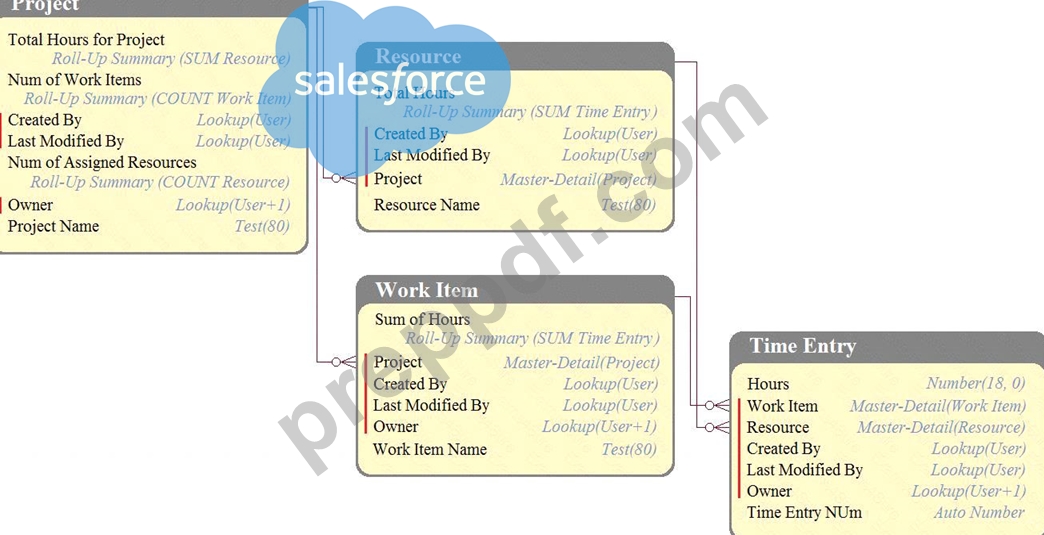
What should the Architect consider in this situation?
- A. Calculate summary values instead of Roll-Up by using workflow.
- B. Load all data after deferring sharing calculations.
- C. Calculate summary values instead of Roll-Up by using triggers.
- D. Load all data using external IDs to link to parent records.
Answer: B
Explanation:
According to the exam guide, one of the objectives is to "describe the use cases and considerations for deferring sharing calculations"1. This implies that option A is the correct way to load large amounts of data into Salesforce without affecting performance and data integrity. Deferring sharing calculations allows the data to be loaded first and then the sharing rules to be applied later2. Option B is not correct because workflows are not recommended for calculating summary values, as they can cause performance issues and data skew3. Option C is not correct because triggers are also not recommended for calculating summary values, as they can cause governor limit errors and data inconsistency. Option D is not correct because external IDs are used to link records from different systems, not to improve data loading performance.
NEW QUESTION # 44
Universal Containers has successfully migrated 50 million records into five different objects multiple times in a full copy sandbox. The Integration Engineer wants to re-run the test again a month before it goes live into Production. What is the recommended approach to re-run the test?
- A. Truncate all 5 objects and hard delete before running the migration test.
- B. Hard delete all 5 objects' data and re-run the data migration test.
- C. Truncate all 5 objects quickly and re-run the data migration test.
- D. Refresh the full copy sandbox and re-run the data migration test.
Answer: D
Explanation:
The recommended approach to re-run the test is to refresh the full copy sandbox and re-run the data migration test. A full copy sandbox is a replica of the production Org, including all data, metadata, and attachments.
Refreshing a full copy sandbox means creating a new copy of the production Org and replacing the existing sandbox. This would ensure that the test is run on a clean and up-to-date environment, without any leftover data or configuration from previous tests. Truncating or hard deleting objects would not be sufficient, because they would not remove all the data or metadata from the sandbox, and they could also affect other dependent objects or processes.
NEW QUESTION # 45
NTO processes orders from its website via an order management system (OMS). The OMS stores over 2 million historical records and is currently not integrated with SF. The Sales team at NTO using Sales cloud and would like visibility into related customer orders yet they do not want to persist millions of records directly in Salesforce. NTO has asked the data architect to evaluate SF connect and the concept of data verification. Which 3 considerations are needed prior to a SF Connect implementation?
Choose 3 answers:
- A. Identify the external tables to sync into external objects
- B. Develop an object relationship strategy.
- C. Configure a middleware tool to poll external table data
- D. Create a 2nd system Admin user for authentication to the external source.
- E. Assess whether the external data source is reachable via an ODATA endpoint.
Answer: A,B,E
Explanation:
The three considerations needed prior to a SF Connect implementation are to develop an object relationship strategy, identify the external tables to sync into external objects, and assess whether the external data source is reachable via an ODATA endpoint. SF Connect is a feature that allows integrating external data sources with Salesforce using external objects. External objects are similar to custom objects, but they store metadata only and not data. They enable on-demand access to external data via standard Salesforce APIs and user interfaces. To implement SF Connect, a data architect needs to consider how the external objects will relate to other objects in Salesforce, which external tables will be exposed as external objects, and whether the external data source supports ODATA protocol for data access.
NEW QUESTION # 46
UC has to built a B2C ecommerce site on Heroku that shares customer and order data with a Heroku Postgres database. UC is currently utilizing Postgres as the single source of truth for both customers and orders. UC has asked a data architect to replicate the data into salesforce so that salesforce can now act as the system of record.
What are the 3 considerations that data architect should weigh before implementing this requirement? Choose 23 answers:
- A. Ensure the data is CRM center and able to populate standard of custom objects.
- B. A selection of the tool required to replicate the data.
- C. Consider whether the data is required for sales reports, dashboards and KPI's.
- D. Ensure there is a tight relationship between order data and an enterprise resource plaining (ERP) application.
- E. Determine if the data is driver of key process implemented within salesforce.
Answer: B,D,E
Explanation:
a. - Heroku Connect is required but this is confusing
Explanation:
Before replicating the data from Heroku Postgres to Salesforce, the data architect should consider the following factors:
Whether the data is a driver of key processes implemented within Salesforce. For example, if the data is used for workflows, triggers, or validation rules, it should be replicated to Salesforce.
Whether there is a tight relationship between order data and an enterprise resource planning (ERP) application. For example, if the order data needs to be synchronized with the ERP system, it should be replicated to Salesforce.
The selection of the tool required to replicate the data. For example, Heroku Connect can be used to bi-directionally sync data between Heroku Postgres and Salesforce
NEW QUESTION # 47
NTO has 1 million customer records spanning 25 years. As part of its new SF project, NTO would like to create a master data management strategy to help preserve the history and relevance of its customer data.
Which 3 activities will be required to identify a successful master data management strategy? Choose 3 answers:
- A. Define the systems of record for critical data
- B. Create a data archive strategy
- C. Choose a Business Intelligence tool.
- D. Identify data to be replicated
- E. Install a data warehouse
Answer: A,B,D
Explanation:
The three activities that will be required to identify a successful master data management strategy are:
Identify data to be replicated: This activity involves determining which data elements need to be copied from one system to another, and how frequently the replication should occur. This can help ensure data consistency and availability across systems.
Create a data archive strategy: This activity involves defining how historical data will be stored, accessed, and deleted over time. This can help optimize data storage, performance, and compliance.
Define the systems of record for critical data: This activity involves identifying which system owns and maintains the authoritative version of each data element. This can help avoid data conflicts and duplication across systems67.
Install a data warehouse is not a required activity, but rather a possible option for consolidating data from multiple sources for analytics purposes. Choose a Business Intelligence tool is not a required activity, but rather a possible option for visualizing and reporting on data from various sources.
NEW QUESTION # 48
Universal Containers (UC) wants to store product data in Salesforce, but the standard Product object does not support the more complex hierarchical structure which is currently being used in the product master system. How can UC modify the standard Product object model to support a hierarchical data structure in order to synchronize product data from the source system to Salesforce?
- A. Create a custom lookup filed on the standard Product to reference the child record in the hierarchy.
- B. Create a custom master-detail field on the standard Product to reference the child record in the hierarchy.
- C. Create an Apex trigger to synchronize the Product Family standard picklist field on the Product object.
- D. Create a custom lookup field on the standard Product to reference the parent record in the hierarchy.
Answer: D
NEW QUESTION # 49
Universals Containers' system administrators have been complaining that they are not able to make changes to its users' record, including moving them to new territories without getting "unable to lock row" errors. This is causing the system admins to spend hours updating user records every day.
What should the data architect do to prevent the error?
- A. Increase CPU for the Salesforce org.
- B. Reduce number of users updated concurrently.
- C. Enable granular locking.
- D. Analyze Splunk query to spot offending records.
Answer: C
NEW QUESTION # 50
Universal Containers (UC) plans to implement consent management for its customers to be compliant with General Data Protection Regulation (GDPR). UC has the following requirements:
UC uses Person Accounts and Contacts in Salesforce for its customers.
Data Protection and Privacy is enabled in Salesforce.
Consent should be maintained in both these objects.
UC plans to verify the consent provided by customers before contacting them through email or phone.
Which option should the data architect recommend to implement these requirements?
- A. Delete contact information from customers who have declined consent to be contacted.
- B. Build Custom object to store consent information in Person Account and Contact, validate against this object before contacting customers.
- C. Use the Consent Management Feature to validate consent provide under the person Account and Contact that is provided by the customer.
- D. Configure custom fields in Person Account and Contact to store consent provided by customers, and validate consent against the fields.
Answer: C
Explanation:
Using the Consent Management Feature to validate consent provided under the person Account and Contact that is provided by the customer (option C) is the best option to implement these requirements, as it allows UC to store and manage consent preferences for Person Accounts and Contacts using native Salesforce features and tools. Configuring custom fields in Person Account and Contact to store consent provided by customers and validate consent against the fields (option A) or building Custom object to store consent information in Person Account and Contact and validate against this object before contacting customers (option B) are not good options, as they may require more customization and maintenance effort, and they do not leverage the existing Data Protection and Privacy feature. Deleting contact information from customers who have declined consent to be contacted (option D) is also not a good option, as it may cause data loss or compliance issues, and it does not allow UC to track or update consent preferences.
NEW QUESTION # 51
Universal Containers (UC) is implementing Salesforce Sales Cloud and Service Cloud. As part of their implementation, they are planning to create a new custom object (Shipments), which will have a lookup relationship to Opportunities. When creating shipment records, Salesforce users need to manually input a customer reference, which is provided by customers, and will be stored in the Customer_Reference__c text custom field. Support agents will likely use this customer reference to search for Shipment records when resolving shipping issues. UC is expecting to have around 5 million shipment records created per year. What is the recommended solution to ensure that support agents using global search and reports can quickly find shipment records?
- A. Set Customer-Reference_c as an External ID (unique).
- B. Implement an archiving process for shipment records created after three years.
- C. Implement an archiving process for shipment records created after five years.
- D. Set Customer-Reference_c as an External ID (non-unique).
Answer: A
Explanation:
Setting Customer-Reference_c as an External ID (unique) is the recommended solution to ensure that support agents using global search and reports can quickly find shipment records. This is because external ID fields are indexed and can be used as filters in reports and list views4. Making the field unique also ensures that there are no duplicate values that could confuse the search results.
NEW QUESTION # 52
A national nonprofit organization is using Salesforce to recruit members. The recruitment process requires a member to be matched with a volunteer opportunity. Given the following:
1. A record is created in Project__ c and used to track the project through completion.
2. The member may then start volunteering and is required to track their volunteer hours, which is stored in VTOTime_c object related to the project.
3. Ability to view or edit the VTOTime__c object needs to be the same as the Project__ c record.
4. Managers must see total hours volunteered while viewing the Project__ c record.
Which data relationship should the data architect use to support this requirement when creating the custom VTOTime__c object?
- A. Master Detail field on Project _c to VTOTime _c showing a list of VTOTime_c Records in a related list.
- B. Master Detail Field on VTOTime_ c to Project_c with rollup summary field on Project __c showing sum of hours from VTOTime_c records.
- C. Lookup Field on Project_c to VTOTime_c displaying a list of VTOTime__c in a related list.
- D. Lookup field on VTOTime_c to Project_c with formula filed on Project__ c showing Sum of hours from VTOTime__c records.
Answer: B
Explanation:
A master-detail field on VTOTime__c to Project__c is the data relationship that the data architect should use to support the requirement when creating the custom VTOTime__c object. A master-detail relationship creates a parent-child relationship between two objects, where the master record controls certain behaviors of the detail record, such as security, ownership, deletion, and roll-up summary fields. By using a master-detail field on VTOTime__c to Project__c, you can ensure that the ability to view or edit the VTOTime__c object is the same as the Project__c record, and that managers can see the total hours volunteered while viewing the Project__c record using a roll-up summary field.
NEW QUESTION # 53
Universal Containers (UC) has over 10 million accounts with an average of 20 opportunities with each account. A Sales Executive at UC needs to generate a daily report for all opportunities in a specific opportunity stage.
Which two key considerations should be made to make sure the performance of the report is not degraded due to large data volume?
- A. Number of records returned by report query.
- B. Number of characters in report query.
- C. Number of queries running at a time.
- D. Number of joins used in report query.
Answer: A,D
NEW QUESTION # 54
Universal Containers has multiple systems all containing and maintaining customer dat a. Although point-to-point integrations are in place, customers are complaining about consistency in the data.
What solution should the data architect recommend?
- A. Data cleanse each system
- B. An MDM solution as the customer master, with centralized integrations to ensure consistency across all systems.
- C. Perform a onetime synchronization to level set the built up inconsistencies
- D. Improve existing point-to-point integrations
Answer: B
Explanation:
Master data management (MDM) is a solution that helps organizations manage their master data across multiple systems and ensure consistency and quality. An MDM solution can act as the customer master, with centralized integrations to other systems, to avoid data duplication and inconsistency.
NEW QUESTION # 55
A custom pricing engine for a Salesforce customer has to be decided by factors with the following hierarchy:
State in which the customer is located
City in which the customer is located if available
Zip code in which the customer is located if available
Changes to this information should have minimum code changes
What should a data architect recommend to maintain this information for the custom pricing engine that is to be built in Salesforce?
- A. Create a custom object to maintain the pricing criteria.
- B. Assign the pricing criteria within customer pricing engine.
- C. Configure the pricing criteria in price books.
- D. Maintain require pricing criteria in custom metadata types.
Answer: D
Explanation:
According to the Get Started with Custom Metadata Types unit on Trailhead, one of the use cases for custom metadata types is to define custom charges for an accounting app. The unit states that "Say that your org uses a standard accounting app. You can create a custom metadata type that defines custom charges, like duties and VAT rates. Then you can write some Apex code that calculates the total amount due for each invoice by using the metadata from your custom metadata type." Therefore, a similar approach can be used to maintain the pricing criteria for a custom pricing engine in Salesforce.
NEW QUESTION # 56
......
Data-Architect Practice Test Pdf Exam Material: https://certkingdom.preppdf.com/Salesforce/Data-Architect-prepaway-exam-dumps.html