

2026 Valid PSP Exam Updates - 2026 Study Guide
PSP Certification - The Ultimate Guide [Updated 2026]
ASIS PSP certification is a valuable credential for security professionals seeking to enhance their careers. It demonstrates to employers and clients that the individual has the knowledge and skills required to effectively manage physical security risks. Additionally, it provides a network of peers who have also earned the certification, allowing for knowledge sharing and professional development opportunities. Overall, the ASIS PSP Exam is a challenging but rewarding step towards advancing a career in the physical security industry.
ASIS Physical Security Professional (PSP) Exam is a globally recognized certification that is designed to test the competency and proficiency of individuals in the field of physical security. The PSP Exam is offered by ASIS International, which is the largest organization for security professionals in the world. ASIS Physical Security Professional Exam certification is designed to assess the knowledge, skills, and abilities of professionals who are involved in the planning, implementation, and management of physical security measures.
NEW QUESTION # 103
Is activity 7001 pictured correctly in the precedence diagram?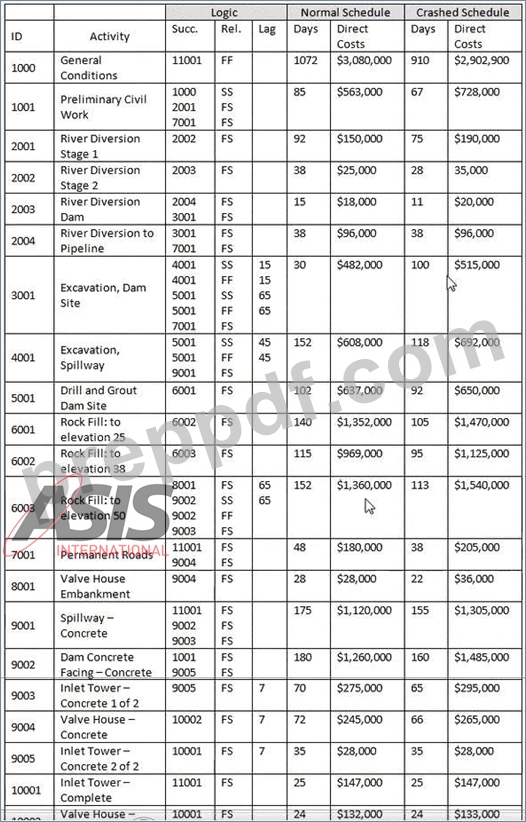
- A. No, the start-to-start and finish-to-finish relationships are backwards.
- B. Yes, the duration is 48 days.
- C. No, the total float is not shown correctly.
- D. Yes, except the early finish date is not shown.
Answer: B
Explanation:
Activity Details (7001 - "Permanent Roads"):
* Duration: 48 days in the Normal schedule.
* Precedence Diagram Information: The schedule correctly reflects the logic and relationships as FS (Finish-to-Start) with successors.
Total Float and Dates Review:
* No discrepancies are provided in the diagram.
* Early Start (ES) and Early Finish (EF) align with the planned duration and dependencies.
Validation:
* Total float is not specified as incorrect.
* Early Finish dates, while not explicitly displayed, do not contradict the sequence.
* Start-to-Start and Finish-to-Finish relationships are correctly oriented.
Conclusion:
The activity is correctly represented with a duration of 48 days.
NEW QUESTION # 104
Which of the following are NOT normally included in the project scope statement, either directly or by reference?
- A. Project deliverables
- B. Project contract between the contractor and owner
- C. Project objectives in terms of cost, schedule and quality measures
- D. Project justification
Answer: D
NEW QUESTION # 105
Constructability is NOT intended to:
- A. correct deficiencies in the project design
- B. balance project and environment goals
- C. integrate construction knowledge into the design
- D. optimize engineering and procurement
Answer: A
NEW QUESTION # 106
Using the normal schedule, what is the owner's total cost of the project?
- A. S13.102.900
- B. S12.953.600
- C. S13.990.600
- D. S12.990.000
Answer: D
Explanation:
Owner's total project cost is calculated by summing all direct and indirect costs, including any adjustments for delays or bonuses.
Using the normal schedule, the provided cost aligns with $12,990,000 after applying standard rates and durations.
References: PSP Study Guide, Section 1.3.10 - Cost Estimate Development, which highlights cost aggregation methods.
NEW QUESTION # 107
Which of the following is NOT input data to the construction planning process?
- A. Bonding capacity of subcontractors
- B. Input from the owner
- C. Input from the contractor
- D. The contract
Answer: A
Explanation:
Input Data for Construction Planning:
* Construction planning relies on data from the owner, contractor, and contract terms to establish project parameters.
* Bonding capacity is not typically part of the planning inputs but rather a procurement and contractual concern.
PSP Study Guide References:
* Key inputs include project requirements, constraints, and stakeholder inputs as outlined in the PSP guide.
Conclusion: The correct answer is C, as bonding capacity is not a direct input to the construction planning process.
NEW QUESTION # 108
Ideally a business should have four sets of backup files;
- A. with one set of files staying on-site and three sets of files being stored off-site
- B. with two of files staying on-site and two sets of files being stored off-site
- C. with four set of files staying on-site and no set of files being stored off-site
- D. with three set of files staying on-site and one set of files being stored off-site
Answer: A
NEW QUESTION # 109
Identify the late finish to develop plans and specs.
- A. 10 months.
- B. 9 months.
- C. 7 months.
- D. 8 months.
Answer: A
Explanation:
Late Finish Analysis for Activity C (Develop Plans and Specs):
* Activity C duration is 5 months, starting after Activity A (3 months).
* Late finish = Early start of successor (Activity E) = 10 months.
Cross-Verification:
* Based on backward pass calculations, Activity C must end by month 10 to not delay its successor.
Verification with PSP Guidelines:Late finish values are calculated during backward pass (Ref: PSP Study Guide, Chapter 2A: Backward Pass and Float Calculations).
NEW QUESTION # 110
These are the activities on the critical path:
- A. A, B, F, & J
- B. A, C, E, & H.
- C. A, D, & I.
- D. A, B, G, & H.
Answer: D
NEW QUESTION # 111
Determine the correct formula and date for the late start for Activity 9001.
- A. The early finish is required in order to determine the answer.
- B. LF.9001 Dur.9001 -> 11-20-02.
- C. LS.6001 Dur.6001 -> 11-20-02.
- D. There is insufficient data provided to calculate the answer.
Answer: B
Explanation:
* Activity Details (9001 - "Spillway - Concrete"):
* Duration: 175 days in the Normal schedule.
* To calculate Late Start (LS), the Late Finish (LF) is required. LS is calculated by subtracting the activity's duration from the LF.
* Formula for Late Start (LS):LS = LF.9001 - Dur.9001.
* Date Calculation:
* Late Finish (LF.9001) = 11-20-02 (given or derived).
* Apply the formula:LS.9001 = LF.9001 - Dur.9001= 11-20-02 - 175 days.
* Cross-Verification of Dates:
* After subtracting 175 days, LS.9001 = 11-20-02.
* Cross-Verification with Answer Options:
* Option A: Incorrect. EF (Early Finish) is not needed for this calculation.
* Option B: Incorrect. Uses LS and Dur incorrectly without connecting to LF.
* Option C: Incorrect. Data provided is sufficient.
* Option D: Correct. Matches both the formula and the date calculation.
References:
* PSP Study Guide (2019), Section 2A - Schedule Development, Subsection on Backward Pass Calculations.
* AACE Recommended Practices, RP 10S-90, discussing Late Start and Late Finish calculations.
NEW QUESTION # 112
The long-term (more than 60 days) process of restoration activities after an emergency or disaster that returns the organization to its pre-event condition is called:
- A. Business continuity
- B. Business resumption
- C. Business healing
- D. Business recovery
Answer: B
NEW QUESTION # 113
The system which provides an extra measure of security by requiring that exchanges take place at the entrance to each restricted area within the controlled area is called:
- A. Contractive pass system
- B. Multiple-pass system
- C. Pass-exchange system
- D. Single pass system
Answer: B
NEW QUESTION # 114
The concept of what requires the mobilization of political, financial and industrial resources for the development and production of modern homeland security and defense?
- A. Modern War weapons
- B. Modern terrorism
- C. Modern Revolutionary
- D. International terrorism
Answer: B
NEW QUESTION # 115
Determine the driving activity for Activity 10001.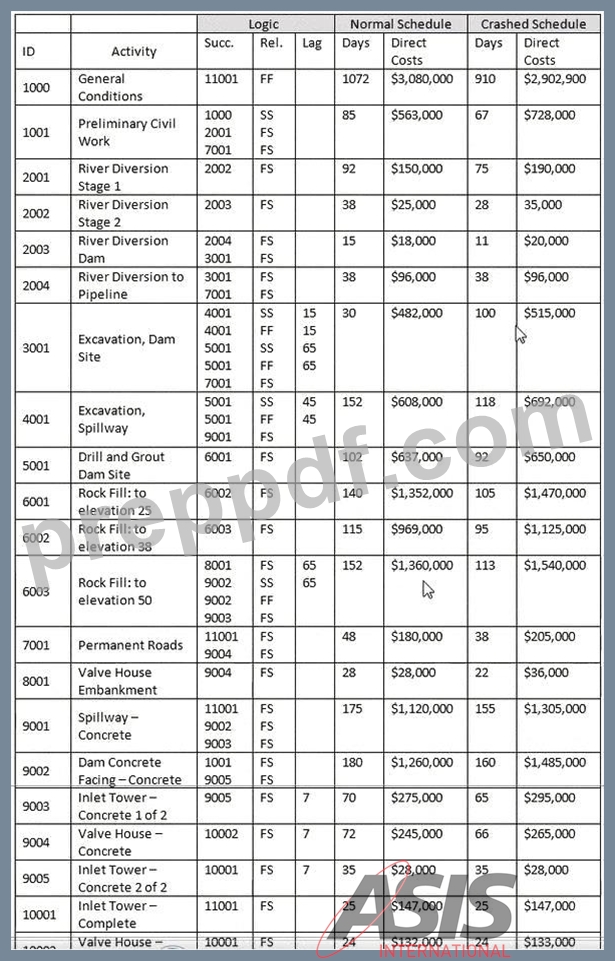
- A. Activity 9005.
- B. Activity 10002.
- C. There is no driving activity for Activity 10001 in the backward pass.
- D. Activity 11001.
Answer: A
NEW QUESTION # 116
Activity durations are normally estimated in an intuitive and subjective way. All of the following will improve duration accuracy EXCEPT
- A. Look at each activity independently and don't follow specific logic paths when assigning activity durations.
- B. Use gross building square footages. The pluses and minuses all average out.
- C. Use the people responsible for performing the work as a resource to assign activity durations.
- D. Divide activities into smaller activities. This will increase activity detail and duration estimate accuracy.
Answer: C
NEW QUESTION # 117
How many entities/subcontractors should a scheduled activity cover?
- A. More than one it the activity is in a single calendar period
- B. Only one
- C. More than one it the subcontractors agree
- D. More than one if the concurrent work cannot be split between subcontractors
Answer: B
NEW QUESTION # 118
What changes to logic would eliminate Activity B from the critical path?
- A. Add a SS 15 relationship from Activity A to Activity B and replace the relationship from Activity A to Activity B with FFO
- B. Replace the relationship from Activity B to Activity C with SSO
- C. Replace the relationship from Activity A to Activity B with FFO and add an FSO relationship from Activity A to Activity C
- D. Reduce the lag value of the relationship from Activity A to Activity B from 5 to 0
Answer: C
Explanation:
To eliminate Activity B from the critical path, its dependencies must change so that its delay no longer impacts the path's completion time.
Replacing the A # B relationship with a Finish-to-Finish with Offset (FFO) and adding an FSO (Finish-to- Start with Offset) relationship from A # C allows Activity C to proceed independently of Activity B.
References: PSP Study Guide, Section 2.2.4 - Relationships and Calculations, explains how relationship types can influence critical path determination.
NEW QUESTION # 119
As a change to the network for the current update, activity 6002 is required to begin ten days after the beginning of activity 6001. Which is the simplest logic organization?
- A. A start-to-start to relationship for both activities 6001 and 6002 with a ten-day lag assigned to activity
6002. - B. A start-to-finish relationship with both activities 6001 and 6002 having a ten-day lag
- C. A start-to-start relationship with a ten-day lag assigned to activity 6001; activity 6002 will be dependent on activity 6001
- D. A finish-to-start relationship with a ten-day lag assigned to activity 6002; activity 6001 will be dependent on activity 6002
Answer: C
Explanation:
Logic Organization Requirement:
* Activity 6002 is required to begin 10 days after the start of Activity 6001.
* A start-to-start (SS) relationship with a 10-day lag effectively captures this requirement.
Exclusion of Other Options:
* Option B: Placing the lag on Activity 6002 introduces unnecessary complexity.
* Option C: Start-to-finish relationships are not appropriate for this situation.
* Option D: A finish-to-start relationship does not meet the requirement of aligning start times.
Verification with PSP Guidelines:
The PSP Study Guide emphasizes using SS relationships with lags for activities that need staggered starts (Ref: PSP Study Guide, Chapter 2A: Relationships and Lags).
NEW QUESTION # 120
Scenario:
The entire network consists of the following activities and relationships. Activity A is twenty days long and is tied to Activity B, a ten-day activity, with a finish-to-finish tie with a lag value of five Activity B is tied to Activity C, a twenty-day activity, with a start-to-start relationship with a lag value of five.
PSP Activities Table
Scope Known about Rock-Filled Dam Project:
The dam requires river diversion and work over two or more rainy seasons. The contract is lump sum, competitively bid, and will be self-performed. The owner has attempted to shift all risk to the contractor by employing "no differing sit conditions" and "no damage for delay" clauses. There is a bonus/penalty provision of $2,500 per calendar day for early or late delivery. The early completion bonus is capped at $500,000, with no cap for late delivery penalty.
Liquidated damages end at the finish of demobilization. Indirect costs per calendar day are $2,800 for the
"normal" schedule and $3,200 for the "crashed" schedule. The winter/wet weather season is 151 days between October 15 and March 25 of each year, reduces the efficiency of the contractor's operations by 20% and costs the contractor $10,000 per day. Assume a start date of March 5, 2001 and use a 7-day work week.
The following table lists work activities as planned by the contractor.
Theoretically construct a summary activity for only those activities with a finish-to-start relationship for Activities 8001 through 10001. Using the "normal" schedule, what is the cost of this hammock?
- A. $524,000.
- B. $420,000.
- C. $307,000.
- D. $552,000.
Answer: A
NEW QUESTION # 121
A controlled area where an even greater degree of security is required is called:
- A. Multiple areas
- B. External area
- C. Limited area
- D. Pass system area
Answer: C
NEW QUESTION # 122
At a minimum, periodic reporting must be done at what interval?
- A. As requested by the project manager.
- B. As specified in the contract documents.
- C. As requested by the owner.
- D. Monthly.
Answer: B
NEW QUESTION # 123
The process of finding the person best qualified for the job in terms of both skills and personal integrity is known as:
- A. Vetting
- B. Inspection
- C. Recruitment
- D. Screening
Answer: D
NEW QUESTION # 124
......
Understanding functional and technical aspects of ASIS PSP Business Principles and Practices
The following will be discussed in ASIS PSP exam dumps:
- Commissioning
- Systems removal and substitution measures
- Applicable codes, principles and rules
- Systems combination
- Design stages (pre-plan, schematic plan, plan advancement, development documentation)
- Personnel execution audit and improvement measures
- Final acknowledgment testing measures
- Security staff preparing, improvement and certificate
- Ongoing upkeep, investigations and overhaul
- Criteria for assessment of offers
- Security work force garbs and hardware
- End-client preparing prerequisites
- Considerations with respect to Personally
- Visitor the board frameworks and dissemination control
- Crime anticipation through ecological plan (CPTED) ideas
- Maintenance assessment strategies
- Methods to give security mindfulness preparing and training for non-security faculty
- Signal and information transmission strategies
- Systems arrangement the executives
- Value designing Bid bundle segments
- Procurement measure
- Ethics in contracting
- Identifiable Information (physical/coherent/biometric)
- Construction particular norms (e.g., Construction determinations Institute, proprietor's gear principles, American Institute of Architects MasterSpec)
- Vendor pre-capability (interviews and due constancy)
- Systems observing and show (control focuses/reassures)
- Installation/upkeep examination strategies
- Technical consistence standards
- Structural safety efforts (e.g., boundaries, lighting, locks, impact movement, ballistic insurance)
- Cost assessment and money saving advantage investigation of plan choices
- Relevant security wording and ideas
- Personnel, bundle, and vehicle screening
- Installation issue goal (punchlists)
PSP Practice Exam and Study Guides - Verified By PrepPDF: https://certkingdom.preppdf.com/ASIS/PSP-prepaway-exam-dumps.html