

100% Reliable Microsoft Data-Engineer-Associate Exam Dumps Test Pdf Exam Material
Based on Official Syllabus Topics of Actual Amazon Data-Engineer-Associate Exam
NEW QUESTION # 39
A company loads transaction data for each day into Amazon Redshift tables at the end of each day. The company wants to have the ability to track which tables have been loaded and which tables still need to be loaded.
A data engineer wants to store the load statuses of Redshift tables in an Amazon DynamoDB table. The data engineer creates an AWS Lambda function to publish the details of the load statuses to DynamoDB.
How should the data engineer invoke the Lambda function to write load statuses to the DynamoDB table?
- A. Use the Amazon Redshift Data API to publish an event to Amazon EventBridqe. Configure an EventBridge rule to invoke the Lambda function.
- B. Use a second Lambda function to invoke the first Lambda function based on AWS CloudTrail events.
- C. Use a second Lambda function to invoke the first Lambda function based on Amazon CloudWatch events.
- D. Use the Amazon Redshift Data API to publish a message to an Amazon Simple Queue Service (Amazon SQS) queue. Configure the SQS queue to invoke the Lambda function.
Answer: A
Explanation:
The Amazon Redshift Data API enables you to interact with your Amazon Redshift data warehouse in an easy and secure way. You can use the Data API to run SQL commands, such as loading data into tables, without requiring a persistent connection to the cluster. The Data API also integrates with Amazon EventBridge, which allows you to monitor the execution status of your SQL commands and trigger actions based on events. By using the Data API to publish an event to EventBridge, the data engineer can invoke the Lambda function that writes the load statuses to the DynamoDB table. This solution is scalable, reliable, and cost-effective. The other options are either not possible or not optimal. You cannot use a second Lambda function to invoke the first Lambda function based on CloudWatch or CloudTrail events, as these services do not capture the load status of Redshift tables. You can use the Data API to publish a message to an SQS queue, but this would require additional configuration and polling logic to invoke the Lambda function from the queue. This would also introduce additional latency and cost. References:
Using the Amazon Redshift Data API
Using Amazon EventBridge with Amazon Redshift
AWS Certified Data Engineer - Associate DEA-C01 Complete Study Guide, Chapter 2: Data Store Management, Section 2.2: Amazon Redshift
NEW QUESTION # 40
A company uses AWS Step Functions to orchestrate a data pipeline. The pipeline consists of Amazon EMR jobs that ingest data from data sources and store the data in an Amazon S3 bucket. The pipeline also includes EMR jobs that load the data to Amazon Redshift.
The company's cloud infrastructure team manually built a Step Functions state machine. The cloud infrastructure team launched an EMR cluster into a VPC to support the EMR jobs. However, the deployed Step Functions state machine is not able to run the EMR jobs.
Which combination of steps should the company take to identify the reason the Step Functions state machine is not able to run the EMR jobs? (Choose two.)
- A. Check the retry scenarios that the company configured for the EMR jobs. Increase the number of seconds in the interval between each EMR task. Validate that each fallback state has the appropriate catch for each decision state. Configure an Amazon Simple Notification Service (Amazon SNS) topic to store the error messages.
- B. Use AWS CloudFormation to automate the Step Functions state machine deployment. Create a step to pause the state machine during the EMR jobs that fail. Configure the step to wait for a human user to send approval through an email message. Include details of the EMR task in the email message for further analysis.
- C. Verify that the Step Functions state machine code has all IAM permissions that are necessary to create and run the EMR jobs. Verify that the Step Functions state machine code also includes IAM permissions to access the Amazon S3 buckets that the EMR jobs use. Use Access Analyzer for S3 to check the S3 access properties.
- D. Query the flow logs for the VPC. Determine whether the traffic that originates from the EMR cluster can successfully reach the data providers. Determine whether any security group that might be attached to the Amazon EMR cluster allows connections to the data source servers on the informed ports.
- E. Check for entries in Amazon CloudWatch for the newly created EMR cluster. Change the AWS Step Functions state machine code to use Amazon EMR on EKS. Change the IAM access policies and the security group configuration for the Step Functions state machine code to reflect inclusion of Amazon Elastic Kubernetes Service (Amazon EKS).
Answer: C,D
Explanation:
To identify the reason why the Step Functions state machine is not able to run the EMR jobs, the company should take the following steps:
Verify that the Step Functions state machine code has all IAM permissions that are necessary to create and run the EMR jobs. The state machine code should have an IAM role that allows it to invoke the EMR APIs, such as RunJobFlow, AddJobFlowSteps, and DescribeStep. The state machine code should also have IAM permissions to access the Amazon S3 buckets that the EMR jobs use as input and output locations. The company can use Access Analyzer for S3 to check the access policies and permissions of the S3 buckets12. Therefore, option B is correct.
Query the flow logs for the VPC. The flow logs can provide information about the network traffic to and from the EMR cluster that is launched in the VPC. The company can use the flow logs to determine whether the traffic that originates from the EMR cluster can successfully reach the data providers, such as Amazon RDS, Amazon Redshift, or other external sources. The company can also determine whether any security group that might be attached to the EMR cluster allows connections to the data source servers on the informed ports. The company can use Amazon VPC Flow Logs or Amazon CloudWatch Logs Insights to query the flow logs3 . Therefore, option D is correct.
Option A is incorrect because it suggests using AWS CloudFormation to automate the Step Functions state machine deployment. While this is a good practice to ensure consistency and repeatability of the deployment, it does not help to identify the reasonwhy the state machine is not able to run the EMR jobs. Moreover, creating a step to pause the state machine during the EMR jobs that fail and wait for a human user to send approval through an email message is not a reliable way to troubleshoot the issue. The company should use the Step Functions console or API to monitor the execution history and status of the state machine, and use Amazon CloudWatch to view the logs and metrics of the EMR jobs .
Option C is incorrect because it suggests changing the AWS Step Functions state machine code to use Amazon EMR on EKS. Amazon EMR on EKS is a service that allows you to run EMR jobs on Amazon Elastic Kubernetes Service (Amazon EKS) clusters. While this service has some benefits, such as lower cost and faster execution time, it does not support all the features and integrations that EMR on EC2 does, such as EMR Notebooks, EMR Studio, and EMRFS. Therefore, changing the state machine code to use EMR on EKS may not be compatible with the existing data pipeline and may introduce new issues.
Option E is incorrect because it suggests checking the retry scenarios that the company configured for the EMR jobs. While this is a good practice to handle transient failures and errors, it does not help to identify the root cause of why the state machine is not able to run the EMR jobs. Moreover, increasing the number of seconds in the interval between each EMR task may not improve the success rate of the jobs, and may increase the execution time and cost of the state machine. Configuring an Amazon SNS topic to store the error messages may help to notify the company of any failures, but it does not provide enough information to troubleshoot the issue.
References:
1: Manage an Amazon EMR Job - AWS Step Functions
2: Access Analyzer for S3 - Amazon Simple Storage Service
3: Working with Amazon EMR and VPC Flow Logs - Amazon EMR
[4]: Analyzing VPC Flow Logs with Amazon CloudWatch Logs Insights - Amazon Virtual Private Cloud
[5]: Monitor AWS Step Functions - AWS Step Functions
[6]: Monitor Amazon EMR clusters - Amazon EMR
[7]: Amazon EMR on Amazon EKS - Amazon EMR
NEW QUESTION # 41
A company is migrating a legacy application to an Amazon S3 based data lake. A data engineer reviewed data that is associated with the legacy application. The data engineer found that the legacy data contained some duplicate information.
The data engineer must identify and remove duplicate information from the legacy application data.
Which solution will meet these requirements with the LEAST operational overhead?
- A. Write a custom extract, transform, and load (ETL) job in Python. Import the Python dedupe library. Use the dedupe library to perform data deduplication.
- B. Write an AWS Glue extract, transform, and load (ETL) job. Usethe FindMatches machine learning(ML) transform to transform the data to perform data deduplication.
- C. Write a custom extract, transform, and load (ETL) job in Python. Use the DataFramedrop duplicatesf) function by importingthe Pandas library to perform data deduplication.
- D. Write an AWS Glue extract, transform, and load (ETL) job. Import the Python dedupe library. Use the dedupe library to perform data deduplication.
Answer: B
Explanation:
AWS Glue is a fully managed serverless ETL service that can handle data deduplication with minimal operational overhead. AWS Glue provides a built-in ML transform called FindMatches, which can automatically identify and group similar records in a dataset. FindMatches can also generate a primary key for each group of records and remove duplicates. FindMatches does not require any coding or prior ML experience, as it can learn from a sample of labeled data provided by the user. FindMatches can also scale to handle large datasets and optimize the cost and performance of the ETL job. References:
AWS Glue
FindMatches ML Transform
AWS Certified Data Engineer - Associate DEA-C01 Complete Study Guide
NEW QUESTION # 42
A retail company has a customer data hub in an Amazon S3 bucket. Employees from many countries use the data hub to support company-wide analytics. A governance team must ensure that the company's data analysts can access data only for customers who are within the same country as the analysts.
Which solution will meet these requirements with the LEAST operational effort?
- A. Register the S3 bucket as a data lake location in AWS Lake Formation. Use the Lake Formation row-level security features to enforce the company's access policies.
- B. Create a separate table for each country's customer data. Provide access to each analyst based on the country that the analyst serves.
- C. Load the data into Amazon Redshift. Create a view for each country. Create separate 1AM roles for each country to provide access to data from each country. Assign the appropriate roles to the analysts.
- D. Move the data to AWS Regions that are close to the countries where the customers are. Provide access to each analyst based on the country that the analyst serves.
Answer: A
Explanation:
AWS Lake Formation is a service that allows you to easily set up, secure, and manage data lakes. One of the features of Lake Formation is row-level security, which enables you to control access to specific rows or columns of data based on the identity or role of the user. This feature is useful for scenarios where you need to restrict access to sensitive or regulated data, such as customer data from different countries. By registering the S3 bucket as a data lake location in Lake Formation, you can use the Lake Formation console or APIs to define and apply row-level security policies to the data in the bucket. You can also use Lake Formation blueprints to automate the ingestion and transformation of data from various sources into the data lake. This solution requires the least operational effort compared to the other options, as it does not involve creating or moving data, or managing multiple tables, views, or roles. References:
AWS Lake Formation
Row-Level Security
AWS Certified Data Engineer - Associate DEA-C01 Complete Study Guide, Chapter 4: Data Lakes and Data Warehouses, Section 4.2: AWS Lake Formation
NEW QUESTION # 43
A company receives .csv files that contain physical address data. The data is in columns that have the following names: Door_No, Street_Name, City, and Zip_Code. The company wants to create a single column to store these values in the following format: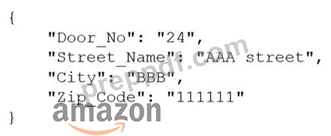
Which solution will meet this requirement with the LEAST coding effort?
- A. Use AWS Glue DataBrew to read the files. Use the PIVOT transformation to create the new column.
- B. Use AWS Glue DataBrew to read the files. Use the NEST TO ARRAY transformation to create the new column.
- C. Use AWS Glue DataBrew to read the files. Use the NEST TO MAP transformation to create the new column.
- D. Write a Lambda function in Python to read the files. Use the Python data dictionary type to create the new column.
Answer: C
Explanation:
The NEST TO MAP transformation allows you to combine multiple columns into a single column that contains a JSON object with key-value pairs. This is the easiest way to achieve the desired format for the physical address data, as you can simply select the columns to nest and specify the keys for each column. The NEST TO ARRAY transformation creates a single column that contains an array of values, which is not thesame as the JSON object format. The PIVOT transformation reshapes the data by creating new columns from unique values in a selected column, which is not applicable for this use case. Writing a Lambda function in Python requires more coding effort than using AWS Glue DataBrew, which provides a visual and interactive interface for data transformations. References:
7 most common data preparation transformations in AWS Glue DataBrew (Section: Nesting and unnesting columns) NEST TO MAP - AWS Glue DataBrew (Section: Syntax)
NEW QUESTION # 44
A company uses Amazon RDS to store transactional data. The company runs an RDS DB instance in a private subnet. A developer wrote an AWS Lambda function with default settings to insert, update, or delete data in the DB instance.
The developer needs to give the Lambda function the ability to connect to the DB instance privately without using the public internet.
Which combination of steps will meet this requirement with the LEAST operational overhead? (Choose two.)
- A. Update the network ACL of the private subnet to include a self-referencing rule that allows access through the database port.
- B. Attach the same security group to the Lambda function and the DB instance. Include a self-referencing rule that allows access through the database port.
- C. Turn on the public access setting for the DB instance.
- D. Update the security group of the DB instance to allow only Lambda function invocations on the database port.
- E. Configure the Lambda function to run in the same subnet that the DB instance uses.
Answer: B,E
Explanation:
To enable the Lambda function to connect to the RDS DB instance privately without using the public internet, the best combination of steps is to configure the Lambda function to run in the same subnet that the DB instance uses, and attach the same security group to the Lambda function and the DB instance. This way, the Lambda function and the DB instance can communicate within the same private network, and the security group can allow traffic between them on the database port. This solution has the least operational overhead, as it does not require any changes to the public access setting, the network ACL, or the security group of the DB instance.
The other options are not optimal for the following reasons:
A: Turn on the public access setting for the DB instance. This option is not recommended, as it would expose the DB instance to the public internet, which can compromise the security and privacy of the data. Moreover, this option would not enable the Lambda function to connect to the DB instance privately, as it would still require the Lambda function to use the public internet to access the DB instance.
B: Update the security group of the DB instance to allow only Lambda function invocations on the database port. This option is not sufficient, as it would only modify the inbound rules of the security group of the DB instance, but not the outbound rules of the security group of the Lambda function.
Moreover, this option would not enable the Lambda function to connect to the DB instance privately, as it would still require the Lambda function to use the public internet to access the DB instance.
E: Update the network ACL of the private subnet to include a self-referencing rule that allows access through the database port. This option is not necessary, as the network ACL of the private subnet already allows all traffic within the subnet by default. Moreover, this option would not enable the Lambda function to connect to the DB instance privately, as it would still require the Lambda function to use the public internet to access the DB instance.
References:
1: Connecting to an Amazon RDS DB instance
2: Configuring a Lambda function to access resources in a VPC
3: Working with security groups
4: Network ACLs
NEW QUESTION # 45
A company needs to build a data lake in AWS. The company must provide row-level data access and column-level data access to specific teams. The teams will access the data by using Amazon Athena, Amazon Redshift Spectrum, and Apache Hive from Amazon EMR.
Which solution will meet these requirements with the LEAST operational overhead?
- A. UseAmazon S3 for data lake storage. Use AWS Lake Formation to restrict data access by rows and columns. Provide data access through AWS Lake Formation.
- B. Use Amazon S3 for data lake storage. Use S3 access policies to restrict data access by rows and columns. Provide data access throughAmazon S3.
- C. Use Amazon Redshift for data lake storage. Use Redshift security policies to restrict data access byrows and columns. Provide data accessby usingApache Spark and Amazon Athena federated queries.
- D. Use Amazon S3 for data lake storage. Use Apache Ranger through Amazon EMR to restrict data access byrows and columns. Providedata access by using Apache Pig.
Answer: A
Explanation:
Option D is the best solution to meet the requirements with the least operational overhead because AWS Lake Formation is a fully managed service that simplifies the process of building, securing, and managing data lakes. AWS Lake Formation allows you to define granular data access policies at the row and column level for different users and groups. AWS Lake Formation also integrates with Amazon Athena, Amazon Redshift Spectrum, and Apache Hive on Amazon EMR, enabling these services to access the data in the data lake through AWS Lake Formation.
Option A is not a good solution because S3 access policies cannot restrict data access by rows and columns.
S3 access policies are based on the identity and permissions of the requester, the bucket and object ownership, and the object prefix and tags. S3 access policies cannot enforce fine-grained data access control at the row and column level.
Option B is not a good solution because it involves using Apache Ranger and Apache Pig, which are not fully managed services and require additional configuration and maintenance. Apache Ranger is a framework that provides centralized security administration for data stored in Hadoop clusters, such as Amazon EMR. Apache Ranger can enforce row-level and column-level access policies for Apache Hive tables. However, Apache Ranger is not a native AWS service and requires manual installation and configuration on Amazon EMR clusters. Apache Pig is a platform that allows you to analyze large data sets using a high-level scripting language called Pig Latin. Apache Pig can access data stored in Amazon S3 and process it using Apache Hive.
However,Apache Pig is not a native AWS service and requires manual installation and configuration on Amazon EMR clusters.
Option C is not a good solution because Amazon Redshift is not a suitable service for data lake storage.
Amazon Redshift is a fully managed data warehouse service that allows you to run complex analytical queries using standard SQL. Amazon Redshift can enforce row-level and column-level access policies for different users and groups. However, Amazon Redshift is not designed to store and process large volumes of unstructured or semi-structured data, which are typical characteristics of data lakes. Amazon Redshift is also more expensive and less scalable than Amazon S3 for data lake storage.
References:
AWS Certified Data Engineer - Associate DEA-C01 Complete Study Guide
What Is AWS Lake Formation? - AWS Lake Formation
Using AWS Lake Formation with Amazon Athena - AWS Lake Formation
Using AWS Lake Formation with Amazon Redshift Spectrum - AWS Lake Formation Using AWS Lake Formation with Apache Hive on Amazon EMR - AWS Lake Formation Using Bucket Policies and User Policies - Amazon Simple Storage Service Apache Ranger Apache Pig What Is Amazon Redshift? - Amazon Redshift
NEW QUESTION # 46
A company is migrating on-premises workloads to AWS. The company wants to reduce overall operational overhead. The company also wants to explore serverless options.
The company's current workloads use Apache Pig, Apache Oozie, Apache Spark, Apache Hbase, and Apache Flink. The on-premises workloads process petabytes of data in seconds. The company must maintain similar or better performance after the migration to AWS.
Which extract, transform, and load (ETL) service will meet these requirements?
- A. AWS Glue
- B. Amazon EMR
- C. AWS Lambda
- D. Amazon Redshift
Answer: A
Explanation:
AWS Glue is a fully managed serverless ETL service that can handle petabytes of data in seconds. AWS Glue can run Apache Spark and Apache Flink jobs without requiring any infrastructure provisioning or management. AWS Glue can also integrate with Apache Pig, Apache Oozie, and Apache Hbase using AWS Glue Data Catalog and AWS Glue workflows. AWS Glue can reduce the overall operational overhead by automating the data discovery, data preparation, and data loading processes. AWS Glue can also optimize the cost and performance of ETL jobs by using AWS Glue Job Bookmarking, AWS Glue Crawlers, and AWS Glue Schema Registry. References:
AWS Glue
AWS Glue Data Catalog
AWS Glue Workflows
[AWS Glue Job Bookmarking]
[AWS Glue Crawlers]
[AWS Glue Schema Registry]
[AWS Certified Data Engineer - Associate DEA-C01 Complete Study Guide]
NEW QUESTION # 47
A company currently stores all of its data in Amazon S3 by using the S3 Standard storage class.
A data engineer examined data access patterns to identify trends. During the first 6 months, most data files are accessed several times each day. Between 6 months and 2 years, most data files are accessed once or twice each month. After 2 years, data files are accessed only once or twice each year.
The data engineer needs to use an S3 Lifecycle policy to develop new data storage rules. The new storage solution must continue to provide high availability.
Which solution will meet these requirements in the MOST cost-effective way?
- A. Transition objects to S3 One Zone-Infrequent Access (S3 One Zone-IA) after 6 months. Transfer objects to S3 Glacier Flexible Retrieval after 2 years.
- B. Transition objects to S3 Standard-Infrequent Access (S3 Standard-IA) after 6 months. Transfer objects to S3 Glacier Flexible Retrieval after 2 years.
- C. Transition objects to S3 One Zone-Infrequent Access (S3 One Zone-IA) after 6 months. Transfer objects to S3 Glacier Deep Archive after 2 years.
- D. Transition objects to S3 Standard-Infrequent Access (S3 Standard-IA) after 6 months. Transfer objects to S3 Glacier Deep Archive after 2 years.
Answer: D
Explanation:
To achieve the most cost-effective storage solution, the data engineer needs to use an S3 Lifecycle policy that transitions objects to lower-cost storage classes based on their access patterns, and deletes them when they are no longer needed. The storage classes should also provide high availability, which means they should be resilient to the loss of data in a single Availability Zone1. Therefore, the solution must include the following steps:
Transition objects to S3 Standard-Infrequent Access (S3 Standard-IA) after 6 months. S3 Standard-IA is designed for data that is accessed less frequently, but requires rapid access when needed. It offers the same high durability, throughput, and low latency as S3 Standard, but with a lower storage cost and a retrieval fee2. Therefore, it is suitablefor data files that are accessed once or twice each month. S3 Standard-IA also provides high availability, as it stores data redundantly across multiple Availability Zones1.
Transfer objects to S3 Glacier Deep Archive after 2 years. S3 Glacier Deep Archive is the lowest-cost storage class that offers secure and durable storage for data that is rarely accessed and can tolerate a
12-hour retrieval time. It is ideal for long-term archiving and digital preservation3. Therefore, it is suitable for data files that are accessed only once or twice each year. S3 Glacier Deep Archive also provides high availability, as it stores data across at least three geographically dispersed Availability Zones1.
Delete objects when they are no longer needed. The data engineer can specify an expiration action in the S3 Lifecycle policy to delete objects after a certain period of time. This will reduce the storage cost and comply with any data retention policies.
Option C is the only solution that includes all these steps. Therefore, option C is the correct answer.
Option A is incorrect because it transitions objects to S3 One Zone-Infrequent Access (S3 One Zone-IA) after
6 months. S3 One Zone-IA is similar to S3 Standard-IA, but it stores data in a single Availability Zone. This means it has a lower availability and durability than S3 Standard-IA, and it is not resilient to the loss of data in a single Availability Zone1. Therefore, it does not provide high availability as required.
Option B is incorrect because it transfers objects to S3 Glacier Flexible Retrieval after 2 years. S3 Glacier Flexible Retrieval is a storage class that offers secure and durable storage for data that is accessed infrequently and can tolerate a retrieval time of minutes to hours. It is more expensive than S3 Glacier Deep Archive, and it is not suitable for data that is accessed only once or twice each year3. Therefore, it is not the most cost-effective option.
Option D is incorrect because it combines the errors of option A and B. It transitions objects to S3 One Zone-IA after 6 months, which does not provide high availability, and it transfers objects to S3 Glacier Flexible Retrieval after 2 years, which is not the most cost-effective option.
References:
1: Amazon S3 storage classes - Amazon Simple Storage Service
2: Amazon S3 Standard-Infrequent Access (S3 Standard-IA) - Amazon Simple Storage Service
3: Amazon S3 Glacier and S3 Glacier Deep Archive - Amazon Simple Storage Service
[4]: Expiring objects - Amazon Simple Storage Service
[5]: Managing your storage lifecycle - Amazon Simple Storage Service
[6]: Examples of S3 Lifecycle configuration - Amazon Simple Storage Service
[7]: Amazon S3 Lifecycle further optimizes storage cost savings with new features - What's New with AWS
NEW QUESTION # 48
A company stores daily records of the financial performance of investment portfolios in .csv format in an Amazon S3 bucket. A data engineer uses AWS Glue crawlers to crawl the S3 data.
The data engineer must make the S3 data accessible daily in the AWS Glue Data Catalog.
Which solution will meet these requirements?
- A. Create an IAM role that includes the AWSGlueServiceRole policy. Associate the role with the crawler.Specify the S3 bucket path of the source data as the crawler's data store. Allocate data processing units (DPUs) to run the crawler every day. Configure the output destination to a new path in the existing S3 bucket.
- B. Create an IAM role that includes the AmazonS3FullAccess policy. Associate the role with the crawler.
Specify the S3 bucket path of the source data as the crawler's data store. Create a daily schedule to run the crawler. Configure the output destination to a new path in the existing S3 bucket. - C. Create an IAM role that includes the AWSGlueServiceRole policy. Associate the role with the crawler.
Specify the S3 bucket path of the source data as the crawler's data store. Create a daily schedule to run the crawler. Specify a database name for the output. - D. Create an IAM role that includes the AmazonS3FullAccess policy. Associate the role with the crawler.
Specify the S3 bucket path of the source data as the crawler's data store. Allocate data processing units (DPUs) to run the crawler every day. Specify a database name for the output.
Answer: C
Explanation:
To make the S3 data accessible daily in the AWS Glue Data Catalog, the data engineer needs to create a crawler that can crawl the S3 data and write the metadata to the Data Catalog. The crawler also needs to run on a daily schedule to keep the Data Catalog updated with the latest data. Therefore, the solution must include the following steps:
Create an IAM role that has the necessary permissions to access the S3 data and the Data Catalog. The AWSGlueServiceRole policy is a managed policy that grants these permissions1.
Associate the role with the crawler.
Specify the S3 bucket path of the source data as the crawler's data store. The crawler will scan the data and infer the schema and format2.
Create a daily schedule to run the crawler. The crawler will run at the specified time every day and update the Data Catalog with any changes in the data3.
Specify a database name for the output. The crawler will create or update a table in the Data Catalog under the specified database. The table will contain the metadata about the data in the S3 bucket, such as the location, schema, and classification.
Option B is the only solution that includes all these steps. Therefore, option B is the correct answer.
Option A is incorrect because it configures the output destination to a new path in the existing S3 bucket. This is unnecessary and may cause confusion, as the crawler does not write any data to the S3 bucket, only metadata to the Data Catalog.
Option C is incorrect because it allocates data processing units (DPUs) to run the crawler every day. This is also unnecessary, as DPUs are only used for AWS Glue ETL jobs, not crawlers.
Option D is incorrect because it combines the errors of option A and C. It configures the output destination to a new path in the existing S3 bucket and allocates DPUs to run the crawler every day, both of which are irrelevant for the crawler.
References:
1: AWS managed (predefined) policies for AWS Glue - AWS Glue
2: Data Catalog and crawlers in AWS Glue - AWS Glue
3: Scheduling an AWS Glue crawler - AWS Glue
[4]: Parameters set on Data Catalog tables by crawler - AWS Glue
[5]: AWS Glue pricing - Amazon Web Services (AWS)
NEW QUESTION # 49
A company stores details about transactions in an Amazon S3 bucket. The company wants to log all writes to the S3 bucket into another S3 bucket that is in the same AWS Region.
Which solution will meet this requirement with the LEAST operational effort?
- A. Configure an S3 Event Notifications rule for all activities on the transactions S3 bucket to invoke an AWS Lambda function. Program the Lambda function to write the events to the logs S3 bucket.
- B. Create a trail of management events in AWS CloudTraiL. Configure the trail to receive data from the transactions S3 bucket. Specify an empty prefix and write-only events. Specify the logs S3 bucket as the destination bucket.
- C. Create a trail of data events in AWS CloudTraiL. Configure the trail to receive data from the transactions S3 bucket. Specify an empty prefix and write-only events. Specify the logs S3 bucket as the destination bucket.
- D. Configure an S3 Event Notifications rule for all activities on the transactions S3 bucket to invoke an AWS Lambda function. Program the Lambda function to write the event to Amazon Kinesis Data Firehose. Configure Kinesis Data Firehose to write the event to the logs S3 bucket.
Answer: C
Explanation:
This solution meets the requirement of logging all writes to the S3 bucket into another S3 bucket with the least operational effort. AWS CloudTrail is a service that records the API calls made to AWS services, including Amazon S3. By creating a trail of data events, you can capture the details of the requests that are made to the transactions S3 bucket, such as the requester, the time, the IP address, and the response elements.
By specifying an empty prefix and write-only events, you can filter the data events to only include the ones that write to the bucket. By specifying the logs S3 bucket as the destination bucket, you can store the CloudTrail logs in another S3 bucket that is in the same AWS Region. This solution does not require any additional coding or configuration, and it is more scalable and reliable than using S3 Event Notifications and Lambda functions. References:
Logging Amazon S3 API calls using AWS CloudTrail
Creating a trail for data events
Enabling Amazon S3 server access logging
NEW QUESTION # 50
A data engineer uses Amazon Redshift to run resource-intensive analytics processes once every month. Every month, the data engineer creates a new Redshift provisioned cluster. The data engineer deletes the Redshift provisioned cluster after the analytics processes are complete every month. Before the data engineer deletes the cluster each month, the data engineer unloads backup data from the cluster to an Amazon S3 bucket.
The data engineer needs a solution to run the monthly analytics processes that does not require the data engineer to manage the infrastructure manually.
Which solution will meet these requirements with the LEAST operational overhead?
- A. Use Amazon Step Functions to pause the Redshift cluster when the analytics processes are complete and to resume the cluster to run new processes every month.
- B. Use Amazon Redshift Serverless to automatically process the analytics workload.
- C. Use AWS CloudFormation templates to automatically process the analytics workload.
- D. Use the AWS CLI to automatically process the analytics workload.
Answer: B
Explanation:
Amazon Redshift Serverless is a new feature of Amazon Redshift that enables you to run SQL queries on data in Amazon S3 without provisioning or managing any clusters. You can use Amazon Redshift Serverless to automatically process the analytics workload, as it scales up and down the compute resources based on the query demand, and charges you only for the resources consumed. This solution will meet the requirements with the least operational overhead, as it does not require the data engineer to create, delete, pause, or resume any Redshift clusters, or to manage any infrastructure manually. You can use the Amazon Redshift Data API to run queries from the AWS CLI, AWS SDK, or AWS Lambda functions12.
The other options are not optimal for the following reasons:
A: Use Amazon Step Functions to pause the Redshift cluster when the analytics processes are complete and to resume the cluster to run new processes every month. This option is not recommended, as it would still require the data engineer to create and delete a new Redshift provisioned cluster every month, which can incur additional costs and time. Moreover, this option would require the data engineer to use Amazon Step Functions to orchestrate the workflow of pausing and resuming the cluster, which can add complexity and overhead.
C: Use the AWS CLI to automatically process the analytics workload. This option is vague and does not specify how the AWS CLI is used to process the analytics workload. The AWS CLI can be used to run queries on data in Amazon S3 using Amazon Redshift Serverless, Amazon Athena, or Amazon EMR, but each of these services has different features and benefits. Moreover, this option does not address the requirement of not managing the infrastructure manually, as the data engineer may still need to provision and configure some resources, such as Amazon EMR clusters or Amazon Athena workgroups.
D: Use AWS CloudFormation templates to automatically process the analytics workload. This option is also vague and does not specify how AWS CloudFormation templates are used to process the analytics workload. AWS CloudFormation is a service that lets you model and provision AWS resources using templates. You can use AWS CloudFormation templates to create and delete a Redshift provisioned cluster every month, or to create and configure other AWS resources, such as Amazon EMR, Amazon Athena, or Amazon Redshift Serverless. However, this option does not address the requirement of not managing the infrastructure manually, as the data engineer may still need to write and maintain the AWS CloudFormation templates, and to monitor the status and performance of the resources.
References:
1: Amazon Redshift Serverless
2: Amazon Redshift Data API
3: Amazon Step Functions
4: AWS CLI
5: AWS CloudFormation
NEW QUESTION # 51
During a security review, a company identified a vulnerability in an AWS Glue job. The company discovered that credentials to access an Amazon Redshift cluster were hard coded in the job script.
A data engineer must remediate the security vulnerability in the AWS Glue job. The solution must securely store the credentials.
Which combination of steps should the data engineer take to meet these requirements? (Choose two.)
- A. Access the credentials from a configuration file that is in an Amazon S3 bucket by using the AWS Glue job.
- B. Store the credentials in AWS Secrets Manager.
- C. Store the credentials in the AWS Glue job parameters.
- D. Store the credentials in a configuration file that is in an Amazon S3 bucket.
- E. Grant the AWS Glue job 1AM role access to the stored credentials.
Answer: B,E
Explanation:
AWS Secrets Manager is a service that allows you to securely store and manage secrets, such as database credentials, API keys, passwords, etc. You can use Secrets Manager to encrypt, rotate, and audit your secrets, as well as to control access to them using fine-grained policies. AWS Glue is a fully managed service that provides a serverless data integration platform for data preparation, data cataloging, and data loading. AWS Glue jobs allow you to transform and load data from various sources into various targets, using either a graphical interface (AWS Glue Studio) or a code-based interface (AWS Glue console or AWS Glue API).
Storing the credentials in AWS Secrets Manager and granting the AWS Glue job 1AM role access to the stored credentials will meet the requirements, as it will remediate the security vulnerability in the AWS Glue job and securely store the credentials. By using AWS Secrets Manager, you can avoid hard coding the credentials in the job script, which is a bad practice that exposes the credentials to unauthorized access or leakage. Instead, you can store the credentials as a secret in Secrets Manager and reference the secret name or ARN in the job script. You can also use Secrets Manager to encrypt thecredentials using AWS Key Management Service (AWS KMS), rotate the credentials automatically or on demand, and monitor the access to the credentials using AWS CloudTrail. By granting the AWS Glue job 1AM role access to the stored credentials, you can use the principle of least privilege to ensure that only the AWS Glue job can retrieve the credentials from Secrets Manager. You can also use resource-based or tag-based policies to further restrict the access to the credentials.
The other options are not as secure as storing the credentials in AWS Secrets Manager and granting the AWS Glue job 1AM role access to the stored credentials. Storing the credentials in the AWS Glue job parameters will not remediate the security vulnerability, as the job parameters are still visible in the AWS Glue console and API. Storing the credentials in a configuration file that is in an Amazon S3 bucket and accessing the credentials from the configuration file by using the AWS Glue job will not be as secure as using Secrets Manager, as the configuration file may not be encrypted or rotated, and the access to the file may not be audited or controlled. References:
AWS Secrets Manager
AWS Glue
AWS Certified Data Engineer - Associate DEA-C01 Complete Study Guide, Chapter 6: Data Integration and Transformation, Section 6.1: AWS Glue
NEW QUESTION # 52
A company stores datasets in JSON format and .csv format in an Amazon S3 bucket. The company has Amazon RDS for Microsoft SQL Server databases, Amazon DynamoDB tables that are in provisionedcapacity mode, and an Amazon Redshift cluster. A data engineering team must develop a solution that will give data scientists the ability to query all data sources by using syntax similar to SQL.
Which solution will meet these requirements with the LEAST operational overhead?
- A. Use AWS Glue to crawl the data sources. Store metadata in the AWS Glue Data Catalog. Use Redshift Spectrum to query the data. Use SQL for structured data sources. Use PartiQL for data that is stored in JSON format.
- B. Use AWS Glue to crawl the data sources. Store metadata in the AWS Glue Data Catalog. Use AWS Glue jobs to transform data that is in JSON format to Apache Parquet or .csv format. Store the transformed data in an S3 bucket. Use Amazon Athena to query the original and transformed data from the S3 bucket.
- C. Use AWS Lake Formation to create a data lake. Use Lake Formation jobs to transform the data from all data sources to Apache Parquet format. Store the transformed data in an S3 bucket. Use Amazon Athena or Redshift Spectrum to query the data.
- D. Use AWS Glue to crawl the data sources. Store metadata in the AWS Glue Data Catalog. Use Amazon Athena to query the data. Use SQL for structured data sources. Use PartiQL for data that is stored in JSON format.
Answer: D
Explanation:
The best solution to meet the requirements of giving data scientists the ability to query all data sources by using syntax similar to SQL with the least operational overhead is to use AWS Glue to crawl the data sources, store metadata in the AWS Glue Data Catalog, use Amazon Athena to query the data, use SQL for structured data sources, and use PartiQL for data that is stored in JSON format.
AWS Glue is a serverless data integration service that makes it easy to prepare, clean, enrich, and move data between data stores1. AWS Glue crawlers are processes that connect to a data store, progress through a prioritized list of classifiers to determine the schema for your data, and then create metadata tables in the Data Catalog2. The Data Catalog is a persistent metadata store that contains table definitions, job definitions, and other control information to help you manage your AWS Glue components3. You can use AWS Glue to crawl the data sources, such as Amazon S3, Amazon RDS for Microsoft SQL Server, and Amazon DynamoDB, and store the metadata in the Data Catalog.
Amazon Athena is a serverless, interactive query service that makes it easy to analyze data directly in Amazon S3 using standard SQL or Python4. Amazon Athena also supports PartiQL, a SQL-compatible query language that lets you query, insert, update, and delete data from semi-structured and nested data, such as JSON. You can use Amazon Athena to query the data from the Data Catalog using SQL for structured data sources, such as .csv files and relational databases, and PartiQL for data that is stored in JSON format. You can also use Athena to query data from other data sources, such as Amazon Redshift, using federated queries.
Using AWS Glue and Amazon Athena to query all data sources by using syntax similar to SQL is the least operational overhead solution, as you do not need to provision, manage, or scale any infrastructure, and you pay only for the resources you use. AWS Glue charges you based on the compute time and the data processed by your crawlers and ETL jobs1. Amazon Athena charges you based on the amount of data scanned by your queries. You can also reduce the cost and improve the performance of your queries by using compression, partitioning, and columnar formats for your data in Amazon S3.
Option B is not the best solution, as using AWS Glue to crawl the data sources, store metadata in the AWS Glue Data Catalog, and use Redshift Spectrum to query the data, would incur more costs and complexity than using Amazon Athena. Redshift Spectrum is a feature of Amazon Redshift, a fully managed data warehouse service, that allows you to query and join data across your data warehouse and your data lake using standard SQL. While Redshift Spectrum is powerful and useful for many data warehousing scenarios, it is not necessary or cost-effective for querying all data sources by using syntax similar to SQL. Redshift Spectrum charges you based on the amount of data scanned by your queries, which is similar to Amazon Athena, but it also requires you to have an Amazon Redshift cluster, which charges you based on the node type, the number of nodes, and the duration of the cluster5. These costs can add up quickly, especially if you have large volumes of data and complex queries. Moreover, using Redshift Spectrum would introduce additional latency and complexity, as you would have to provision and manage the cluster, and create an external schema and database for the data in the Data Catalog, instead of querying it directly from Amazon Athena.
Option C is not the best solution, as using AWS Glue to crawl the data sources, store metadata in the AWS Glue Data Catalog, use AWS Glue jobs to transform data that is in JSON format to Apache Parquet or .csv format, store the transformed data in an S3 bucket, and use Amazon Athena to query the original and transformed data from the S3 bucket, would incur more costs and complexity than using Amazon Athena with PartiQL. AWS Glue jobs are ETL scripts that you can write in Python or Scala to transform your data and load it to your target data store. Apache Parquet is a columnar storage format that can improve the performance of analytical queries by reducing the amount of data that needs to be scanned and providing efficient compression and encoding schemes6. While using AWS Glue jobs and Parquet can improve the performance and reduce the cost of your queries, they would also increase the complexity and the operational overhead of the data pipeline, as you would have to write, run, and monitor the ETL jobs, and store the transformed data in a separate location in Amazon S3. Moreover, using AWS Glue jobs and Parquet would introduce additional latency, as you would have to wait for the ETL jobs to finish before querying the transformed data.
Option D is not the best solution, as using AWS Lake Formation to create a data lake, use Lake Formation jobs to transform the data from all data sources to Apache Parquet format, store the transformed data in an S3 bucket, and use Amazon Athena or RedshiftSpectrum to query the data, would incur more costs and complexity than using Amazon Athena with PartiQL. AWS Lake Formation is a service that helps you centrally govern, secure, and globally share data for analytics and machine learning7. Lake Formation jobs are ETL jobs that you can create and run using the Lake Formation console or API. While using Lake Formation and Parquet can improve the performance and reduce the cost of your queries, they would also increase the complexity and the operational overhead of the data pipeline, as you would have to create, run, and monitor the Lake Formation jobs, and store the transformed data in a separate location in Amazon S3. Moreover, using Lake Formation and Parquet would introduce additional latency, as you would have to wait for the Lake Formation jobs to finish before querying the transformed data. Furthermore, using Redshift Spectrum to query the data would also incur the same costs and complexity as mentioned in option B. References:
What is Amazon Athena?
Data Catalog and crawlers in AWS Glue
AWS Glue Data Catalog
Columnar Storage Formats
AWS Certified Data Engineer - Associate DEA-C01 Complete Study Guide
AWS Glue Schema Registry
What is AWS Glue?
Amazon Redshift Serverless
Amazon Redshift provisioned clusters
[Querying external data using Amazon Redshift Spectrum]
[Using stored procedures in Amazon Redshift]
[What is AWS Lambda?]
[PartiQL for Amazon Athena]
[Federated queries in Amazon Athena]
[Amazon Athena pricing]
[Top 10 performance tuning tips for Amazon Athena]
[AWS Glue ETL jobs]
[AWS Lake Formation jobs]
NEW QUESTION # 53
A company uses an Amazon Redshift cluster that runs on RA3 nodes. The company wants to scale read and write capacity to meet demand. A data engineer needs to identify a solution that will turn on concurrency scaling.
Which solution will meet this requirement?
- A. Turn on concurrency scaling for the daily usage quota for the Redshift cluster.
- B. Turn on concurrency scaling at the workload management (WLM) queue level in the Redshift cluster.
- C. Turn on concurrency scaling in the settings duringthe creation of andnew Redshift cluster.
- D. Turn on concurrency scaling in workload management (WLM) for Redshift Serverless workgroups.
Answer: B
Explanation:
Concurrency scaling is a feature that allows you to support thousands of concurrent users and queries, with consistently fast query performance. When you turn on concurrency scaling, Amazon Redshift automatically adds query processing power in seconds to process queries without any delays. You can manage which queries are sent to the concurrency-scaling cluster by configuring WLM queues. To turn on concurrency scaling for a queue, set the Concurrency Scaling mode value to auto. The other options are either incorrect or irrelevant, as they do not enable concurrency scaling for the existing Redshift cluster on RA3 nodes. References:
Working with concurrency scaling - Amazon Redshift
Amazon Redshift Concurrency Scaling - Amazon Web Services
Configuring concurrency scaling queues - Amazon Redshift
AWS Certified Data Engineer - Associate DEA-C01 Complete Study Guide (Chapter 6, page 163)
NEW QUESTION # 54
A company is developing an application that runs on Amazon EC2 instances. Currently, the data that the application generates is temporary. However, the company needs to persist the data, even if the EC2 instances are terminated.
A data engineer must launch new EC2 instances from an Amazon Machine Image (AMI) and configure the instances to preserve the data.
Which solution will meet this requirement?
- A. Launch new EC2 instances by using an AMI that is backed by an EC2 instance store volume. Attach an Amazon Elastic Block Store (Amazon EBS) volume to contain the application data. Apply the default settings to the EC2 instances.
- B. Launch new EC2 instances by using an AMI that is backed by an Amazon Elastic Block Store (Amazon EBS) volume. Attach an additional EC2 instance store volume to contain the application data. Apply the default settings to the EC2 instances.
- C. Launch new EC2 instances by using an AMI that is backed by a root Amazon Elastic Block Store (Amazon EBS) volume that contains the application data. Apply the default settings to the EC2 instances.
- D. Launch new EC2 instances by using an AMI that is backed by an EC2 instance store volume that contains the application data. Apply the default settings to the EC2 instances.
Answer: A
Explanation:
Amazon EC2 instances can use two types of storage volumes: instance store volumes and Amazon EBS volumes. Instance store volumes are ephemeral, meaning they are only attached to the instance for the duration of its life cycle. If the instance is stopped, terminated, or fails, the data on the instance store volume is lost.
Amazon EBS volumes are persistent, meaning they can be detached from the instance and attached to another instance, and the data on the volume is preserved. To meet the requirement of persisting the data even if the EC2 instances are terminated, the data engineer must use Amazon EBS volumes to store the application data.
The solution is to launch new EC2 instances by using an AMI that is backed by an EC2 instance store volume, which is the default option for most AMIs. Then, the data engineer must attach an Amazon EBS volume to each instance and configure the application to write the data to the EBS volume. This way, the data will be saved on the EBS volume and can be accessed by another instance if needed. The data engineer can apply the default settings to the EC2 instances, as there is no need to modify the instance type, security group, or IAM role for this solution. The other options are either not feasible or not optimal. Launching new EC2 instances by using an AMI that is backed by an EC2 instance store volume that contains the application data (option A) or by using an AMI that is backed by a root Amazon EBS volume that contains the application data (option B) would not work, as the data on the AMI would be outdated and overwritten by the new instances. Attaching an additional EC2 instance store volume to contain the application data (option D)would not work, as the data on the instance store volume would be lost if the instance is terminated. References:
Amazon EC2 Instance Store
Amazon EBS Volumes
AWS Certified Data Engineer - Associate DEA-C01 Complete Study Guide, Chapter 2: Data Store Management, Section 2.1: Amazon EC2
NEW QUESTION # 55
A company uses Amazon Athena for one-time queries against data that is in Amazon S3. The company has several use cases. The company must implement permission controls to separate query processes and access to query history among users, teams, and applications that are in the same AWS account.
Which solution will meet these requirements?
- A. Create an Athena workgroup for each use case. Apply tags to the workgroup. Create an 1AM policy that uses the tags to apply appropriate permissions to the workgroup.
- B. Create an S3 bucket for each use case. Create an S3 bucket policy that grants permissions to appropriate individual IAM users. Apply the S3 bucket policy to the S3 bucket.
- C. Create an AWS Glue Data Catalog resource policy that grants permissions to appropriate individual IAM users for each use case. Apply the resource policy to the specific tables that Athena uses.
- D. Create an JAM role for each use case. Assign appropriate permissions to the role for each use case.
Associate the role with Athena.
Answer: A
Explanation:
Athena workgroups are a way to isolate query execution and query history among users, teams, and applications that share the same AWS account. By creating a workgroup for each use case, the company can control the access and actions on the workgroup resource using resource-level IAM permissions or identity-based IAM policies. The company can also use tags to organize and identify the workgroups, and use them as conditions in the IAM policies to grant or deny permissions to the workgroup. This solution meets the requirements of separating query processes and access to query history among users, teams, and applications that are in the same AWS account. References:
Athena Workgroups
IAM policies for accessing workgroups
Workgroup example policies
NEW QUESTION # 56
A data engineer must orchestrate a data pipeline that consists of one AWS Lambda function and one AWS Glue job. The solution must integrate with AWS services.
Which solution will meet these requirements with the LEAST management overhead?
- A. Use an AWS Step Functions workflow that includes a state machine. Configure the state machine to run the Lambda function and then the AWS Glue job.
- B. Use an AWS Glue workflow to run the Lambda function and then the AWS Glue job.
- C. Use an Apache Airflow workflow that is deployed on Amazon Elastic Kubernetes Service (Amazon EKS). Define a directed acyclic graph (DAG) in which the first task is to call the Lambda function and the second task is to call the AWS Glue job.
- D. Use an Apache Airflow workflow that is deployed on an Amazon EC2 instance. Define a directed acyclic graph (DAG) in which the first task is to call the Lambda function and the second task is to call the AWS Glue job.
Answer: A
Explanation:
AWS Step Functions is a service that allows you to coordinate multiple AWS services into serverless workflows. You can use Step Functions to create state machines that define the sequence and logic of the tasks in your workflow. Step Functions supports various types of tasks, such as Lambda functions, AWS Glue jobs, Amazon EMR clusters, Amazon ECS tasks, etc. You can use Step Functions to monitor and troubleshoot your workflows, as well as to handle errors and retries.
Using an AWS Step Functions workflow that includes a state machine to run the Lambda function and then the AWS Glue job will meet the requirements with the least management overhead, as it leverages the serverless and managed capabilities of Step Functions. You do not need to write any code to orchestrate the tasks in your workflow, as you can use the Step Functions console or the AWS Serverless Application Model (AWS SAM) to define and deploy your state machine. You also do not need to provision or manage any servers or clusters, as Step Functions scales automatically based on the demand.
The other options are not as efficient as using an AWS Step Functions workflow. Using an Apache Airflow workflow that is deployed on an Amazon EC2 instance or on Amazon Elastic Kubernetes Service (Amazon EKS) will require more management overhead, as you will need to provision, configure, and maintain the EC2 instance or the EKS cluster, as well as the Airflow components. You will also need to write and maintain the Airflow DAGs to orchestrate the tasks in your workflow. Using an AWS Glue workflow to run the Lambda function and then the AWS Glue job will not work, as AWS Glue workflows only support AWS Glue jobs and crawlers as tasks, not Lambda functions. References:
AWS Step Functions
AWS Glue
AWS Certified Data Engineer - Associate DEA-C01 Complete Study Guide, Chapter 6: Data Integration and Transformation, Section 6.3: AWS Step Functions
NEW QUESTION # 57
A company created an extract, transform, and load (ETL) data pipeline in AWS Glue. A data engineer must crawl a table that is in Microsoft SQL Server. The data engineer needs to extract, transform, and load the output of the crawl to an Amazon S3 bucket. The data engineer also must orchestrate the data pipeline.
Which AWS service or feature will meet these requirements MOST cost-effectively?
- A. AWS Glue workflows
- B. Amazon Managed Workflows for Apache Airflow (Amazon MWAA)
- C. AWS Glue Studio
- D. AWS Step Functions
Answer: A
Explanation:
AWS Glue workflows are a cost-effective way to orchestrate complex ETL jobs that involve multiple crawlers, jobs, and triggers. AWS Glue workflows allow you to visually monitor the progress and dependencies of your ETL tasks, and automatically handle errors and retries. AWS Glue workflows also integrate with other AWS services, such as Amazon S3, Amazon Redshift, and AWS Lambda, among others, enabling you to leverage these services for your data processing workflows. AWS Glue workflows are serverless, meaning you only pay for the resources you use, and you don't have to manage any infrastructure.
AWS Step Functions, AWS Glue Studio, and Amazon MWAA are also possible options for orchestrating ETL pipelines, but they have some drawbacks compared to AWS Glue workflows. AWS Step Functions is a serverless function orchestrator that can handle different types of data processing, such as real-time, batch, and stream processing. However, AWS Step Functions requires you to write code to define your state machines, which can be complex and error-prone. AWS Step Functions also charges you for every state transition, which can add up quickly for large-scale ETL pipelines.
AWS Glue Studio is a graphical interface that allows you to create and run AWS Glue ETL jobs without writing code. AWS Glue Studio simplifies the process of building, debugging, and monitoring your ETL jobs, and provides a range of pre-built transformations and connectors. However, AWS Glue Studio does not support workflows, meaning you cannot orchestrate multiple ETL jobs or crawlers with dependencies and triggers. AWS Glue Studio also does not support streaming data sources or targets, which limits its use cases for real-time data processing.
Amazon MWAA is a fully managed service that makes it easy to run open-source versions of Apache Airflow on AWS and build workflows to run your ETL jobs and data pipelines. Amazon MWAA provides a familiar and flexible environment for data engineers who are familiar with Apache Airflow, and integrates with a range of AWS services such as Amazon EMR, AWS Glue, and AWS Step Functions. However, Amazon MWAA is not serverless, meaning you have to provision and pay for the resources you need, regardless of your usage.
Amazon MWAA also requires you to write code to define your DAGs, which can be challenging and time-consuming for complex ETL pipelines. References:
AWS Glue Workflows
AWS Step Functions
AWS Glue Studio
Amazon MWAA
AWS Certified Data Engineer - Associate DEA-C01 Complete Study Guide
NEW QUESTION # 58
A media company uses software as a service (SaaS) applications to gather data by using third-party tools. The company needs to store the data in an Amazon S3 bucket. The company will use Amazon Redshift to perform analytics based on the data.
Which AWS service or feature will meet these requirements with the LEAST operational overhead?
- A. Amazon Managed Streaming for Apache Kafka (Amazon MSK)
- B. Amazon Kinesis
- C. AWS Glue Data Catalog
- D. Amazon AppFlow
Answer: D
Explanation:
Amazon AppFlow is a fully managed integration service that enables you to securely transfer data between SaaS applications and AWS services like Amazon S3 and AmazonRedshift. Amazon AppFlow supports many SaaS applications as data sources and targets, and allows you to configure data flows with a few clicks.
Amazon AppFlow also provides features such as data transformation, filtering, validation, and encryption to prepare and protect your data. Amazon AppFlow meets the requirements of the media company with the least operational overhead, as it eliminates the need to write code, manage infrastructure, or monitor data pipelines.
References:
Amazon AppFlow
Amazon AppFlow | SaaS Integrations List
Get started with data integration from Amazon S3 to Amazon Redshift using AWS Glue interactive sessions
NEW QUESTION # 59
A data engineer needs to securely transfer 5 TB of data from an on-premises data center to an Amazon S3 bucket. Approximately 5% of the data changes every day. Updates to the data need to be regularlyproliferated to the S3 bucket. The data includes files that are in multiple formats. The data engineer needs to automate the transfer process and must schedule the process to run periodically.
Which AWS service should the data engineer use to transfer the data in the MOST operationally efficient way?
- A. AWS Glue
- B. AWS Direct Connect
- C. AWS DataSync
- D. Amazon S3 Transfer Acceleration
Answer: C
Explanation:
AWS DataSync is an online data movement and discovery service that simplifies and accelerates data migrations to AWS as well as moving data to and from on-premises storage, edge locations, other cloud providers, and AWS Storage services1. AWS DataSync can copy data to and from various sources and targets, including Amazon S3, and handle files in multiple formats. AWS DataSync also supports incremental transfers, meaning it can detect and copy only the changes to the data, reducing the amount of data transferred and improving the performance. AWS DataSync can automate and schedule the transfer process using triggers, and monitor the progress and status of the transfers using CloudWatch metrics and events1.
AWS DataSync is the most operationally efficient way to transfer the data in this scenario, as it meets all the requirements and offers a serverless and scalable solution. AWS Glue, AWS Direct Connect, and Amazon S3 Transfer Acceleration are not the best options for this scenario, as they have some limitations or drawbacks compared to AWS DataSync. AWS Glue is a serverless ETL service that can extract, transform, and load data from various sources to various targets, including Amazon S32. However, AWS Glue is not designed for large-scale data transfers, as it has some quotas and limits on the number and size of files it can process3.
AWS Glue also does not support incremental transfers, meaning it would have to copy the entire data set every time, which would be inefficient and costly.
AWS Direct Connect is a service that establishes a dedicated network connection between your on-premises data center and AWS, bypassing the public internet and improving the bandwidth and performance of the data transfer. However, AWS Direct Connect is not a data transfer service by itself, as it requires additional services or tools to copy the data, such as AWS DataSync, AWS Storage Gateway, or AWS CLI. AWS Direct Connect also has some hardware and location requirements, and charges you for the port hours and data transfer out of AWS.
Amazon S3 Transfer Acceleration is a feature that enables faster data transfers to Amazon S3 over long distances, using the AWS edge locations and optimized network paths. However, Amazon S3 Transfer Acceleration is not a data transfer service by itself, as it requires additional services or tools to copy the data, such as AWS CLI, AWS SDK, or third-party software. Amazon S3 Transfer Acceleration also charges you for the data transferred over the accelerated endpoints, and does not guarantee a performance improvement for every transfer, as it depends on various factors such as the network conditions, the distance, and the object size. References:
AWS DataSync
AWS Glue
AWS Glue quotas and limits
[AWS Direct Connect]
[Data transfer options for AWS Direct Connect]
[Amazon S3 Transfer Acceleration]
[Using Amazon S3 Transfer Acceleration]
NEW QUESTION # 60
A company extracts approximately 1 TB of data every day from data sources such as SAP HANA, Microsoft SQL Server, MongoDB, Apache Kafka, and Amazon DynamoDB. Some of the data sources have undefined data schemas or data schemas that change.
A data engineer must implement a solution that can detect the schema for these data sources. The solution must extract, transform, and load the data to an Amazon S3 bucket. The company has a service level agreement (SLA) to load the data into the S3 bucket within 15 minutes of data creation.
Which solution will meet these requirements with the LEAST operational overhead?
- A. Use Amazon EMR to detect the schema and to extract, transform, and load the data into the S3 bucket.
Create a pipeline in Apache Spark. - B. Create a stored procedure in Amazon Redshift to detect the schema and to extract, transform, and load the data into a Redshift Spectrum table. Access the table from Amazon S3.
- C. Use AWS Glue to detect the schema and to extract, transform, and load the data into the S3 bucket.
Create a pipeline in Apache Spark. - D. Create a PvSpark proqram in AWS Lambda to extract, transform, and load the data into the S3 bucket.
Answer: C
Explanation:
AWS Glue is a fully managed service that provides a serverless data integration platform. It can automatically discover and categorize data from various sources, including SAP HANA, Microsoft SQL Server, MongoDB, Apache Kafka, and Amazon DynamoDB. It can also infer the schema of the data and store it in the AWS Glue Data Catalog, which is a central metadata repository. AWS Glue can then use the schema information to generate and run Apache Spark code to extract, transform, and load the data into an Amazon S3 bucket. AWS Glue can also monitor and optimize the performance and cost of the data pipeline, and handle any schema changes that may occur in the source data. AWS Glue can meet the SLA of loading the data into the S3 bucket within 15 minutes of data creation, as it can trigger the data pipeline based on events, schedules, or on-demand. AWS Glue has the least operational overhead among the options, as it does not require provisioning, configuring, or managing any servers or clusters. It also handles scaling, patching, and security automatically. References:
AWS Glue
[AWS Glue Data Catalog]
[AWS Glue Developer Guide]
AWS Certified Data Engineer - Associate DEA-C01 Complete Study Guide
NEW QUESTION # 61
A data engineer must manage the ingestion of real-time streaming data into AWS. The data engineer wants to perform real-time analytics on the incoming streaming data by using time-based aggregations over a window of up to 30 minutes. The data engineer needs a solution that is highly fault tolerant.
Which solution will meet these requirements with the LEAST operational overhead?
- A. Use an AWS Lambda function that includes both the business and the analytics logic to perform time-based aggregations over a window of up to 30 minutes for the data in Amazon Kinesis Data Streams.
- B. Use Amazon Managed Service for Apache Flink (previously known as Amazon Kinesis Data Analytics) to analyze the data by using multiple types of aggregations to perform time-based analytics over a window of up to 30 minutes.
- C. Use an AWS Lambda function that includes both the business and the analytics logic to perform aggregations for a tumbling window of up to 30 minutes, based on the event timestamp.
- D. Use Amazon Managed Service for Apache Flink (previously known as Amazon Kinesis Data Analytics) to analyze the data that might occasionally contain duplicates by using multiple types of aggregations.
Answer: A
Explanation:
This solution meets the requirements of managing the ingestion of real-time streaming data into AWS and performing real-time analytics on the incoming streaming data with the least operational overhead. Amazon Managed Service for Apache Flink is a fully managed service that allows you to run Apache Flink applications without having to manage any infrastructure or clusters. Apache Flink is a framework for stateful stream processing that supports various types of aggregations, such as tumbling, sliding, and session windows, over streaming data. By using Amazon Managed Service for Apache Flink, you can easily connect to Amazon Kinesis Data Streams as the source and sink of your streaming data, and perform time-based analytics over a window of up to 30 minutes. This solution is also highly fault tolerant, as Amazon Managed Service for Apache Flink automatically scales, monitors, and restarts your Flink applications in case of failures.
References:
Amazon Managed Service for Apache Flink
Apache Flink
Window Aggregations in Flink
NEW QUESTION # 62
A manufacturing company collects sensor data from its factory floor to monitor and enhance operational efficiency. The company uses Amazon Kinesis Data Streams to publish the data that the sensors collect to a data stream. Then Amazon Kinesis Data Firehose writes the data to an Amazon S3 bucket.
The company needs to display a real-time view of operational efficiency on a large screen in the manufacturing facility.
Which solution will meet these requirements with the LOWEST latency?
- A. Use Amazon Managed Service for Apache Flink (previously known as Amazon Kinesis Data Analytics) to process the sensor data. Create a new Data Firehose delivery stream to publish data directly to an Amazon Timestream database. Use the Timestream database as a source to create an Amazon QuickSight dashboard.
- B. Use AWS Glue bookmarks to read sensor data from the S3 bucket in real time. Publish the data to an Amazon Timestream database. Use the Timestream database as a source to create a Grafana dashboard.
- C. Configure the S3 bucket to send a notification to an AWS Lambda function when any new object is created. Use the Lambda function to publish the data to Amazon Aurora. Use Aurora as a source to create an Amazon QuickSight dashboard.
- D. Use Amazon Managed Service for Apache Flink (previously known as Amazon Kinesis Data Analytics) to process the sensor data. Use a connector for Apache Flink to write data to an Amazon Timestream database. Use the Timestream database as a source to create a Grafana dashboard.
Answer: A
Explanation:
This solution will meet the requirements with the lowest latency because it uses Amazon Managed Service for Apache Flink to process the sensor data in real time and write it to Amazon Timestream, a fast, scalable, and serverless time series database. Amazon Timestream is optimized for storing and analyzing time series data, such as sensor data, and can handle trillions of events per day with millisecond latency. By using AmazonTimestream as a source, you can create an Amazon QuickSight dashboard that displays a real-time view of operational efficiency on a large screen in the manufacturing facility. Amazon QuickSight is a fully managed business intelligence service that can connect to various data sources, including Amazon Timestream, and provide interactive visualizations and insights123.
The other options are not optimal for the following reasons:
A: Use Amazon Managed Service for Apache Flink (previously known as Amazon Kinesis Data Analytics) to process the sensor data. Use a connector for Apache Flink to write data to an Amazon Timestream database. Use the Timestream database as a source to create a Grafana dashboard. This option is similar to option C, but it uses Grafana instead of Amazon QuickSight to create the dashboard.
Grafana is an open source visualization tool that can also connect to Amazon Timestream, but it requires additional steps to set up and configure, such as deploying a Grafana server on Amazon EC2, installing the Amazon Timestream plugin, and creating an IAM role for Grafana to access Timestream. These steps can increase the latency and complexity of the solution.
B: Configure the S3 bucket to send a notification to an AWS Lambda function when any new object is created. Use the Lambda function to publish the data to Amazon Aurora. Use Aurora as a source to create an Amazon QuickSight dashboard. This option is not suitable for displaying a real-time view of operational efficiency, as it introduces unnecessary delays and costs in the data pipeline. First, the sensor data is written to an S3 bucket by Amazon Kinesis Data Firehose, which can have a buffering interval of up to 900 seconds. Then, the S3 bucket sends a notification to a Lambda function, which can incur additional invocation and execution time. Finally, the Lambda function publishes the data to Amazon Aurora, a relational database that is not optimized for time series data and can have higher storage and performance costs than Amazon Timestream .
D: Use AWS Glue bookmarks to read sensor data from the S3 bucket in real time. Publish the data to an Amazon Timestream database. Use the Timestream database as a source to create a Grafana dashboard.
This option is also not suitable for displaying a real-time view of operational efficiency, as it uses AWS Glue bookmarks to read sensor data from the S3 bucket. AWS Glue bookmarks are a feature that helps AWS Glue jobs and crawlers keep track of the data that has already been processed, so that they can resume from where they left off. However, AWS Glue jobs and crawlers are not designed for real-time data processing, as they can have a minimum frequency of 5 minutes and a variable start-up time.
Moreover, this option also uses Grafana instead of Amazon QuickSight to create the dashboard, which can increase the latency and complexity of the solution .
References:
1: Amazon Managed Streaming for Apache Flink
2: Amazon Timestream
3: Amazon QuickSight
4: Analyze data in Amazon Timestream using Grafana
5: Amazon Kinesis Data Firehose
6: Amazon Aurora
7: AWS Glue Bookmarks
8: AWS Glue Job and Crawler Scheduling
NEW QUESTION # 63
A data engineer must ingest a source of structured data that is in .csv format into an Amazon S3 data lake. The
.csv files contain 15 columns. Data analysts need to run Amazon Athena queries on one or two columns of the dataset. The data analysts rarely query the entire file.
Which solution will meet these requirements MOST cost-effectively?
- A. Create an AWS Glue extract, transform, and load (ETL) job to read from the .csv structured data source.Configure the job to write the data into the data lake in Apache Parquet format.
- B. Create an AWS Glue extract, transform, and load (ETL) job to read from the .csv structured data source.
Configure the job to ingest the data into the data lake in JSON format. - C. Use an AWS Glue PySpark job to ingest the source data into the data lake in .csv format.
- D. Use an AWS Glue PySpark job to ingest the source data into the data lake in Apache Avro format.
Answer: A
Explanation:
Amazon Athena is a serverless interactive query service that allows you to analyze data in Amazon S3 using standard SQL. Athena supports various data formats, such as CSV,JSON, ORC, Avro, and Parquet. However, not all data formats are equally efficient for querying. Some data formats, such as CSV and JSON, are row-oriented, meaning that they store data as a sequence of records, each with the same fields. Row-oriented formats are suitable for loading and exporting data, but they are not optimal for analytical queries that often access only a subset of columns. Row-oriented formats also do not support compression or encoding techniques that can reduce the data size and improve the query performance.
On the other hand, some data formats, such as ORC and Parquet, are column-oriented, meaning that they store data as a collection of columns, each with a specific data type. Column-oriented formats are ideal for analytical queries that often filter, aggregate, or join data by columns. Column-oriented formats also support compression and encoding techniques that can reduce the data size and improve the query performance. For example, Parquet supports dictionary encoding, which replaces repeated values with numeric codes, and run-length encoding, which replaces consecutive identical values with a single value and a count. Parquet also supports various compression algorithms, such as Snappy, GZIP, and ZSTD, that can further reduce the data size and improve the query performance.
Therefore, creating an AWS Glue extract, transform, and load (ETL) job to read from the .csv structured data source and writing the data into the data lake in Apache Parquet format will meet the requirements most cost-effectively. AWS Glue is a fully managed service that provides a serverless data integration platform for data preparation, data cataloging, and data loading. AWS Glue ETL jobs allow you to transform and load data from various sources into various targets, using either a graphical interface (AWS Glue Studio) or a code-based interface (AWS Glue console or AWS Glue API). By using AWS Glue ETL jobs, you can easily convert the data from CSV to Parquet format, without having to write or manage any code. Parquet is a column-oriented format that allows Athena to scan only the relevant columns and skip the rest, reducing the amount of data read from S3. This solution will also reduce the cost of Athena queries, as Athena charges based on the amount of data scanned from S3.
The other options are not as cost-effective as creating an AWS Glue ETL job to write the data into the data lake in Parquet format. Using an AWS Glue PySpark job to ingest the source data into the data lake in .csv format will not improve the query performance or reduce the query cost, as .csv is a row-oriented format that does not support columnar access or compression. Creating an AWS Glue ETL job to ingest the data into the data lake in JSON format will not improve the query performance or reduce the query cost, as JSON is also a row-oriented format that does not support columnar access or compression. Using an AWS Glue PySpark job to ingest the source data into the data lake in Apache Avro format will improve the query performance, as Avro is a column-oriented format that supports compression and encoding, but it will require more operational effort, as you will need to write and maintain PySpark code to convert the data from CSV to Avro format.
References:
Amazon Athena
Choosing the Right Data Format
AWS Glue
[AWS Certified Data Engineer - Associate DEA-C01 Complete Study Guide], Chapter 5: Data Analysis and Visualization, Section 5.1: Amazon Athena
NEW QUESTION # 64
......
Free Data-Engineer-Associate Dumps are Available for Instant Access: https://certkingdom.preppdf.com/Amazon/Data-Engineer-Associate-prepaway-exam-dumps.html