

100% Free Nutanix Certified Professional (NCP) NCP-EUC Dumps PDF Demo Cert Guide Cover
PDF Exam Material 2024 Realistic NCP-EUC Dumps Questions
NEW QUESTION # 42
What is one key benefit of using Nutanix Validated Designs (NVD) for Citrix VDI deployments?
- A. Determines performance impact during peak I/0
- B. Provides sizing guidance and scaling capabilities.
- C. NVD-based deployments are designed to provide 99.999% up time.
- D. NVD-based deployments are designed to provide Disaster Recovery
Answer: B
Explanation:
Nutanix and Citrix provide a turnkey validated VDI infrastructure solution that allows 10x faster deployments, cuts management time by 70% and significantly reduces the number of support calls. Nutanix eliminates the complexity of managing discrete storage, servers and separate virtualization and networking stacks.
https://webobjects2.cdw.com/is/content/CDW/cdw/on-domain-cdw/brands/bitdefender/vdi-application-virtualization.pdf
NEW QUESTION # 43
During initial testing of a new VD' deployment, users are complaining that they are not seeing the performance increase that was seen during the POC phase of the project.
The POC deployment was tested on an NX line of nodes with AHV as the hypervisor. After the test, the customer has decided to move forward with a production deployment using Dell XC nodes with ESXi as the hypervisor.
Which two actions must be taken. based on the hypervisor and node model change? (Choose two.)
- A. Change power Management
- B. Configure Video Drivers
- C. Disable the C-states.
- D. Update Network Drivers
Answer: C,D
Explanation:
one of the possible causes of poor performance in a VDI deployment is power management, which can affect CPU frequency and performance. Therefore, it is recommended to disable any power saving features on the BIOS level, such as C-states and P-states.
Another possible cause of poor performance is network configuration, which can affect network throughput and latency. Therefore, it is recommended to update network drivers and firmware on the Dell XC nodes with ESXi23, and ensure that they are compatible with Nutanix software.
NEW QUESTION # 44
How should the administrator best organize gold images in a non-persistent Citrix MCS environment?
- A. Build a single gold image with all the applications in the application catalog.
- B. Create a base image without any applications and leverage Microsoft SCCM to deliver applications to the cloned virtual desktops.
- C. Create a gold image based on the user subnet assignment,
- D. Create a gold image for each separate business unit.
Answer: B
Explanation:
https://www.nutanix.com/support-services/training-certification/certifications/certification-details-nutanix-certifi
https://docs.citrix.com/en-us/citrix-daas/install-configure/machine-catalogs-create.html A gold image is a master image that contains the operating system, drivers, patches, and configurations for a virtual desktop. A non-persistent Citrix MCS environment is one where virtual desktops are created from a gold image and discarded after each user session.
Citrix Machine Creation Services (MCS) is a tool that uses a gold image to create and manage virtual machines for Citrix Virtual Apps and Desktops environments. MCS can create different types of machines, such as pooled random, static assigned, or dedicated2.
One of the challenges of using MCS is managing multiple gold images for different user groups or application needs. Updating multiple gold images can be time-consuming and error-prone. Therefore, it is recommended to use a single base image without any applications and leverage another tool such as Microsoft System Center Configuration Manager (SCCM) to deliver applications dynamically to the cloned virtual desktops3.
This approach can simplify image management, reduce storage consumption, improve performance, and enhance user experience. SCCM can also provide additional features such as patch management, compliance enforcement, inventory reporting, etc.3
NEW QUESTION # 45
An organization recently deployed an Active-passive VDI solution across multiple sites within their Nutanix platforms. The Organization is now on phase two of the project, which requires them to consolidate all user profile and home data, since each location will have its own standalone Microsoft File Server.
Which solution will provide a more easily-managed environment for profile and Home Share data that includes High Availability and a unified single namespace?
- A. Nutanix Files
- B. Nutanix Storage Containers
- C. Microsoft FSLogix
- D. Microsoft DFS
Answer: A
Explanation:
Nutanix Files is a software-defined, scale-out file storage solution that provides a repository for unstructured data, such as home directories, user profiles, departmental shares, application logs, backups, and archives1. Nutanix Files also provides high availability and a unified single namespace for easy management2.
NEW QUESTION # 46
How should an administrator protect Writable AppVolumes during a disaster in a Nutanix environment?
- A. Create a storage container in both the primary and DR data centers for the Writeable AppVolumes. Set up asynchronous DR between the two sites.
- B. Enable HA reservations on the cluster to ensure there is capacity in case of failure.
- C. Create a protection domain and add the AppVolumes VM entities to it. Set up a schedule to replicate the VMS every 60 minutes.
- D. Disable HA reservations to ensure that VMS are powered on using best effort during a disaster,
Answer: A
Explanation:
Writable AppVolumes are a feature of VMware App Volumes that provides users with a dedicated virtual disk for storing user profile data and user-installed applications1. Writable AppVolumes are stored as VMDK files on a datastore2.
To protect Writable AppVolumes during a disaster in a Nutanix environment, one possible solution is to use asynchronous DR between two sites. Asynchronous DR allows you to replicate VMs and their associated data from one site to another at regular intervals using protection domains and remote sites3.
https://www.nutanix.com/blog/vmware-app-volumes-on-nutanix
NEW QUESTION # 47
What are two primary purposes of a Frame utility Server? (Choose two.)
- A. shared file server
- B. A server that monitors virtual desktop usage
- C. Test and develop virtual desktops.
- D. Backend for a client-server application
Answer: A,D
Explanation:
Frame utility server is a stand-alone, general purpose Windows server that can be helpful for a variety of use cases, including:
License server: Install a network licensing manager for your software on a Frame utility server. Your production instances can then connect to this server to get the licenses.
Backend for a client-server application: Install a database or other backend service on a Frame utility server. Your production instances can then connect to this server to run your client-server application.
Shared file server: Install a file sharing service on a Frame utility server. Your production instances can then access shared files from this server.
Test and develop virtual desktops: Use a Frame utility server as a sandbox environment to test and develop your virtual desktops before publishing them to your production account.
https://docs.frame.nutanix.com/platform/admin/utility-servers/
NEW QUESTION # 48
An administrator is supporting two Nutanix Io-node AHV clusters (Cluster01 and Cluster02) dedicated for VDI workloads. The administrator has started receiving complaints regarding the performance of several full clone virtual desktops within Cluster01, upon review of both clusters, below are the discovered utilization metrics:
Cluster01 utilizations:
* Cluster CPU:85%
* Cluster Memory: 94%
* storage:50%
Cluster02 utilizations:
* Cluster CPU:30%
* Cluster Memory:35%
* storage:40%
Datacenter policy requires 20% resource overhead.
Which action should the administrator take to resolve this issue?
- A. Review the VM Overview dashboard.
- B. Use X-Ray to migrate the virtual desktops.
- C. use a Recovery Plan to migrate the virtual desktops.
- D. Review the Hardware dashboard.
Answer: C
Explanation:
administrator can take to resolve the issue of performance for several full clone virtual desktops within Cluster01 by migrating them to Cluster02.
a recovery plan is a set of steps that defines how to recover guest VMs from a disaster. A recovery plan can be used to migrate VMs between Nutanix clusters at the same or different availability zones1.
NEW QUESTION # 49
A company is using Citrix for virtual desktops on Nutanix with AHV. The studio has 10,000 users who will be connecting to this infrastructure and have deployed a dedicated Files cluster for holding the user home shares.
Since this is a dedicated cluster with dual Intel 6242 28 GHz 16 Core processors and 192GB of RAM, what should be done for the FSVM and CVM configuration to allow for optimal performance?
- A. Leave the CVM RAM at 32GB and increase the FSVM RAM to 96GB.
- B. Increase the CVM RAM to 64GB and the FSVM RAM to 96GB.
- C. Increase the CVM vCPUs to 16 and the FSW vCPUs to 12.
- D. Leave the CVM vCPUs et 12 and increase the FSVM vCPUs to 8,
Answer: A
Explanation:
https://portal.nutanix.com/page/documents/solutions/details?targetId=TN-2041-Nutanix-Files:file-server-virtual-machines.html
https://next.nutanix.com/files-storage-71/command-line-access-to-nutanix-file-server-vm-fsvm-via-ssh-nutanix-files-33420 The file server VM (FSVM) is a virtual machine that runs on Nutanix Files and provides file services such as SMB shares and NFS exports. The FSVM is based on CentOS and incorporates all the security and hardening that goes into the Nutanix Controller VM (CVM)2. The CVM is a virtual machine that runs on each node of a Nutanix cluster and provides storage management, data protection, cluster coordination, and other services3.
The FSVMs have some default configuration settings that can be changed depending on your workload requirements. For example, you can change the number of vCPUs, RAM, network interfaces, or disk size of an FSVM2. However, you should not change these settings without consulting Nutanix Support first.
One of the factors that affects the performance of an FSVM is its memory allocation. The more memory an FSVM has, the more cache it can use for file operations. This can improve the throughput and latency of file serving workloads4. Therefore, increasing the FSVM RAM to 96GB can help optimize its performance for a large number of users.
NEW QUESTION # 50
What should the administrator use when creating a Windows 10 gold image using Calm for Citrix MCS persistent desktops?
- A. Snapshot of Citrix optimized Windows 10 image.
- B. Sysprepped Microsoft Windows 10 image
- C. VMware optimized Windows 10 image.
- D. Microsoft downloaded Windows 10 ISO image.
Answer: A
Explanation:
A snapshot is a point-in-time copy of a virtual machine that can be used as a template for creating new machines. A Citrix optimized Windows 10 image is a Windows 10 image that has been configured with best practices and optimizations for Citrix Virtual Apps and Desktops.
Using a snapshot of a Citrix optimized Windows 10 image can ensure that the persistent desktops have consistent performance, security, and user experience. It can also simplify the image management process by allowing you to update the snapshot with new patches or applications using Calm.
Calm is a tool that automates application lifecycle management across different environments. Calm can integrate with Citrix MCS to create, update, and delete virtual machines based on blueprints that define the configuration and dependencies of an application.
https://www.nutanix.com/support-services/training-certification/certifications/certification-details-nutanix-certified-professional-ncp-euc-v6
NEW QUESTION # 51
A company has deployed Horizon on a Nutanix cluster running the ESXi hypervisor. They are starting the configuration for the deployment of 1000 virtual desktops running Windows 10 in a Linked Clone Desktop Pool.
The company has these requirements:
* Reduced time for initial virtual desktop deployment
* Fast recompose time when updating the pool with patches and new application installs
* Provide a high level of availability to the pool
What should the company enable, that will allow this Nutanix VDI implementation to meet the stated requirements?
- A. View Composer API for Array Integration
- B. VM disk space reclamation
- C. Separate datastores for replicas and clones
- D. View Storage Accelerator
Answer: A
Explanation:
View Composer API for Array Integration (VCAI) is a feature of VMware Horizon that leverages the native cloning abilities in the storage array to offload storage operations within a VMware View environment12. This feature allows customers to offload the creation of linked clones to the storage array3.
NEW QUESTION # 52
A company has decided to use Citrix Optimizer tool to prepare their gold image.
Which two actions does Optimizer take to improve the gold image creation process? (Choose two.)
- A. Optimizes storage capacity usage.
- B. Applies best practices for securing virtual desktops.
- C. uses built-in templates to perform optimizations.
- D. Optimizes user environments for better performance
Answer: C,D
Explanation:
The Citrix Optimizer tool is used to prepare Windows operating system images for use in a virtual desktop environment. Some of the actions that it takes to improve the gold image creation process include:
Optimizes user environments for better performance: The tool removes unnecessary or redundant services, features, and applications from the image, which can improve performance and reduce resource usage.
Uses built-in templates to perform optimizations: The tool comes with pre-configured templates that are optimized for specific environments, such as virtualdesktops or server workloads. These templates can be customized based on the specific needs of the organization.
https://support.citrix.com/article/CTX224676/citrix-optimizer-tool
https://docs.citrix.com/en-us/workspace-environment-management/service/using-environment-management/syste
NEW QUESTION # 53
A company based out of San Jose, CA, USA is considering deploying a global virtual desktop environment.
Currently. there is no solution for virtual desktops. The company has employees globally and decides to leverage the Public Cloud across multiple regions for their deployment.
Which factor is the most important for choosing a public cloud data center location to optimize for end-user performance?
- A. The data center should be in the same state or country as the end users.
- B. The network latency between the end user and the data center should be minimized,
- C. The combined distance the corporate headquarters, the data center, and the users should be minimized.
- D. The distance from the data center to the end users should be minimized.
Answer: B
Explanation:
one of the factors that affects end-user performance in a virtual desktop environment is network latency, which is the time it takes for data packets to travel between two points on a network.
Therefore, if the company wants to optimize end-user performance, they should choose a public cloud data center location that minimizes the network latency between the end user and the data center.
NEW QUESTION # 54
An administrator is using a mix of full clones and nan-persistent desktops deployed via Citrix MCS on a three-node cluster. The full clone and non-persistent desktops are managed using separate storage containers.
Which two Storage Efficiency features will provide better storage efficiency and performance improvement?
(Choose two.)
- A. RDMA
- B. Erasure Coding
- C. Compression
- D. Deduplication
Answer: C,D
Explanation:
Storage Efficiency features that will provide better storage efficiency and performance improvement for a mix of full clones and non-persistent desktops deployed via Citrix MCS on a three-node cluster are Compression and Deduplication. Compression is a technology that reduces the size of data blocks by removing redundant information. Deduplication is a technology that eliminates duplicate blocks of data and reduces storage consumption. Both Compression and Deduplication can be enabled on a per-container basis and can provide significant savings for Citrix virtual desktop deployments that use cloning technologies such as MCS2.
NEW QUESTION # 55
An administrator is deploying a new virtual desktop environment onto an existing Nutanix solution.
The virtual desktop environment will consist of these elements:
1000 instant clone call center virtual desktops (supporting 5 business units)
500 full clone developer virtual desktops (supporting 2 business units)
150 applications delivered via AppStacks (supporting 7 business units)
How many storage containers should be created to support these workloads?
- A. 0
- B. 1
- C. 2
- D. 3
Answer: D
Explanation:
Based on the given information, the administrator is deploying 1000 instant clone virtual desktops, 500 full clone virtual desktops, and 150 applications. To support these workloads, the Nutanix solution will need multiple storage containers.
According to the Nutanix Certified Professional - End User Computing (NCP-EUC) v6 guide, for VDI workloads, it is recommended to create a separate storage container for each type of desktop (e.g. instant clone, full clone) and another container for AppStacks. It is also recommended to have at least one container for metadata and one container for replicas.
Therefore, for this scenario, a total of 3 storage containers should be created:
One container for 1000 instant clone virtual desktops
One container for 500 full clone virtual desktops
One container for 150 applications delivered via AppStacks
So the answer is C. 3.
NEW QUESTION # 56
Refer the exhibit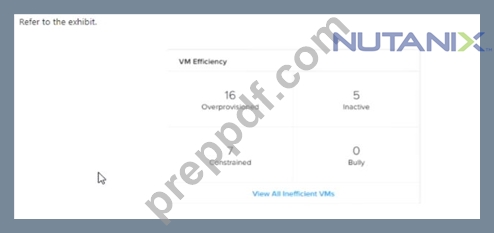
An administrator is getting complaints from users regarding virtual desktop performance. The user base is a mixture of task workers, knowledge workers, and power users. The administrator suspects there are user Virtual desktops that are consuming resources and are starving the other virtual desktops from performing adequately.
How many virtual desktops are contributing to this issue?
- A. 0
- B. 1
- C. 2
- D. 3
Answer: C
Explanation:
The CPU usage percentage indicates how much of the allocated CPU resources the virtual desktop is consuming.
A high CPU usage percentage means that the virtual desktop is using a lot of CPU resources, which can affect the performance of other virtual desktops on the same host or cluster.
According to Nutanix best practices, the recommended CPU usage percentage for virtual desktops is less than 80%.
VM-0001 (99%)
VM-0002 (98%)
VM-0003 (97%)
VM-0004 (96%)
VM-0005 (95%)
VM-0010 (85%)
VM-0016 (81%)
These virtual desktops are likely contributing to the performance issue by consuming too much CPU resources and starving other virtual desktops from performing adequately.
NEW QUESTION # 57
An administrator is migrating Citrix back-end infrastructure to Citrix Cloud.
What three pieces of information are needed to connect Prism to Citrix Cloud?
- A. Customer ID, Client ID. Secret Key
- B. Customer ID, Citrix Cloud Provider, Prism Data Service IP Address
- C. Citrix Login, Secret Key, Passphrase
- D. Prism Data Service IP Address. Client ID, Passphrase
Answer: A
Explanation:
https://docs.citrix.com/en-us/citrix-workspace/integrate.html
The Prism Citrix Cloud integration feature allows you to configure the Citrix Cloud settings in Prism Central and connect your Nutanix cluster as a resource location in Citrix Cloud4. This enables you to use Citrix Virtual Apps and Desktops service to deliver applications and desktops to your end users.
To use this feature, you need to meet some prerequisites, such as:
The Prism Central version must be 2020.11 or later.
The AOS version must be 5.15 LTSR or later.
The hypervisor must be AHV or ESXi.
You must have a valid Citrix Cloud account with access to Citrix Virtual Apps and Desktops service4.
One of the steps for configuring the Prism Citrix Cloud integration is to establish the connection to Citrix Cloud. To do this, you need to provide three pieces of information:
Customer ID: This is a unique identifier for your Citrix Cloud account that can be found in your profile settings2.
Client ID: This is a unique identifier for an API client that can access your Citrix Cloud account. You can create an API client in your identity and access management settings2.
Secret Key: This is a secret string that authenticates the API client. You can generate a secret key when you create an API client2.
NEW QUESTION # 58
An administrator decides to deploy non-persistent virtual desktops for the accounting department. Currently, the department uses physical desktops and users has full administrative rights to their machines.
Which capability will persist for users following a migration to non-persistent VDI desktops?
- A. Application installations
- B. Installing drivers for user peripherals
- C. Saving user data
- D. Saving application configurations
Answer: D
Explanation:
non-persistent VDI desktops are virtual desktops that do not save any changes made by the user after they log off or shut down12. They rely on a master image that contains the OS, configuration settings, and other customizations that replicate to multiple virtual desktops1.
NEW QUESTION # 59
There are 50 people in a legal department who are scheduled to have their laptops replaced with virtual desktops. Their application suite consists of Microsoft Office 365, Photoshop, and an Ip-based application internally developed by the company.
Which option minimizes management overhead of the gold image, while providing the users with access to their application suite?
- A. Citrix Virtual Apps virtual hosted desktop with the application suite built into the gold Image
- B. Persistent virtual machines with the application suite built into the gold image
- C. Remote Desktop Services virtualizing the application suite
- D. Non-persi5tent MCS delivered virtual machines virtualizing the application suite
Answer: D
Explanation:
ersistent virtual machines are those that retain all the user's personal settings, files, and customizations after each session12. Non-persistent virtual machines are those that reset to a predefined state after each session and do not save any user data12. MCS (Machine Creation Services) is a Citrix feature that allows administrators to create and manage multiple virtual machines from a single master image3. Remote Desktop Services (RDS) is a Microsoft feature that allows users to access applications or desktops hosted on a remote server4. Citrix Virtual Apps is a Citrix feature that allows users to access applications hosted on a remote server or cloud5
NEW QUESTION # 60
An administrator needs to configure a license server to be accessible by Frame desktops.
Which server should the administrator configure?
- A. Azure VM Instance
- B. utility Server
- C. Sandbox
- D. EC2 VM Instance
Answer: B
Explanation:
Frame is a cloud-based desktop-as-a-service platform that allows users to access Windows applications and desktops from any device1. A license server is a server that hosts a network licensing manager for software that requires licenses to run2. Frame supports using a utility server as a license server for Frame desktops1. A utility server is a stand-alone, general purpose Windows server that can be configured and managed from the Frame dashboard1.
https://docs.frame.nutanix.com/platform/admin/utility-servers/
NEW QUESTION # 61
An administrator is using a mix of full clones and nan-persistent desktops deployed via Citrix MCS on a three-node cluster. The full clone and non-persistent desktops are managed using separate storage containers.
Which two Storage Efficiency features will provide better storage efficiency and performance improvement? (Choose two.)
- A. RDMA
- B. Erasure Coding
- C. Compression
- D. Deduplication
Answer: C,D
Explanation:
Storage Efficiency features that will provide better storage efficiency and performance improvement for a mix of full clones and non-persistent desktops deployed via Citrix MCS on a three-node cluster are Compression and Deduplication. Compression is a technology that reduces the size of data blocks by removing redundant information. Deduplication is a technology that eliminates duplicate blocks of data and reduces storage consumption. Both Compression and Deduplication can be enabled on a per-container basis and can provide significant savings for Citrix virtual desktop deployments that use cloning technologies such as MCS2.
NEW QUESTION # 62
An administrator plans to deploy a VMWare Horizon Solution on AHV. The administrator used the cluster command to verify if Shadow Clones are enabled in the AHV environment. This command shows the following output: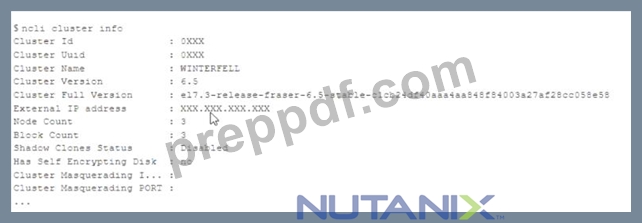
Which action should the administrator take to enable Shadow Clones?
- A. Connect to Prism Central
- B. Connect to the AHV Host by SSH.
- C. Execute the acluster edit-prams enable-shadow-clones=true command.
- D. Execute the cluster enable -cluster_cluster_uuid 0xxx - show_clones=true command.
Answer: D
Explanation:
an action that the administrator should take to enable Shadow Clones for a VMWare Horizon Solution on AHV is Connect to Prism Central and execute the cluster enable -cluster_cluster_uuid 0xxx - show_clones=true command. Shadow Clones are a feature that helps decrease read latency by creating local copies of frequently accessed data blocks on each host2. To enable Shadow Clones, the administrator needs to connect to Prism Central and run a cluster command with the appropriate parameters1.
NEW QUESTION # 63
......
Updated Nutanix NCP-EUC Dumps – PDF & Online Engine: https://certkingdom.preppdf.com/Nutanix/NCP-EUC-prepaway-exam-dumps.html