

Use Real PMI-RMP Dumps - PMI Correct Answers updated on 2026
Project Management Professional PMI-RMP Exam Practice Dumps
The benefit in Obtaining the PMI-RMP Exam Certification
- PMI Risk Management Professional Certifications provide opportunities to get a job easily in which they are interested in instead of wasting years and ending without getting any experience.
- PMI Risk Management Professional will be confident and stand different from others as their skills are more trained than non-certified professionals.
- PMI Risk Management Professional Certification provides practical experience to candidates from all the aspects to be a proficient worker in the organization.
- PMI Risk Management Professional has more useful and relevant networks that help them in setting career goals for themselves. PMI Risk Management Professional Certification provides them with the right career direction than non certified usually are unable to get.
- PMI Risk Management Professional is distinguished among competitors. PMI Risk Management Professional certification can give them an edge at that time easily when candidates appear for a job interview employers seek to notify something which differentiates the individual to another.
PMI-RMP (PMI Risk Management Professional) certification exam is designed to test the candidate's knowledge and skills in risk management. PMI Risk Management Professional certification is offered by the Project Management Institute (PMI), which is a globally recognized organization for project management professionals. The PMI-RMP certification is one of the most sought-after certifications for professionals who are involved in risk management.
The Project Management Institute (PMI) Risk Management Professional (PMI-RMP) certification is a globally recognized and highly respected designation for professionals in the field of risk management. The PMI-RMP certification is designed for individuals who want to demonstrate their expertise in identifying, assessing, and mitigating project risks. PMI Risk Management Professional certification is ideal for project managers, risk managers, and other professionals who are responsible for managing risk in their organizations.
NEW QUESTION # 58
PESTLE, TECOP, and SPECTRUM are three examples of prompt lists that can be used during risk management activities. Prompt lists are used to do which of the following?
- A. Perform a simulation with all prompted risks varying simultaneously.
- B. Simulate risk identification.
- C. Achieve the relative weighting of the risks.
- D. Identity basic causes of risks of more fundamental forces.
Answer: B
Explanation:
Explanation/Reference:
NEW QUESTION # 59
You work as a project manager for BlueWell Inc. You are about to complete the quantitative risk analysis process for your project. You can use three available tools and techniques to complete this process. Which one of the following is NOT a tool or technique that is appropriate for the quantitative risk analysis process?
- A. Expert judgment
- B. Organizational process assets
- C. Data gathering and representation techniques
- D. Quantitative risk analysis and modeling techniques
Answer: B
NEW QUESTION # 60
A project is In the initiation phase. The project stakeholders are Invited to a meeting to share their thoughts that may impact the project In a positive or negative way.
What will be the main output of this meeting?
- A. Evaluating the project's probability of success
- B. Evaluating the project's impact
- C. Performing a qualitative analysis
- D. Identifying threats and opportunities
Answer: D
Explanation:
The main output of the stakeholder meeting in the initiation phase is to identify threats and opportunities that may impact the project in a positive or negative way. This information will be used to develop the risk management plan.
The meeting that the project stakeholders are invited to in the initiation phase is part of the Identify Risks process. The purpose of this process is to identify the risks that may affect the project objectives in a positive or negative way, and to document their characteristics. The main output of this process is the risk register, which is a document that contains the list of identified risks, their causes, potential responses, and other relevant information. The risk register is an essential input for the subsequent risk management processes, such as Perform Qualitative Risk Analysis, Perform Quantitative Risk Analysis, Plan Risk Responses, and Monitor Risks. Therefore, the correct answer is B. Identifying threats and opportunities. Reference: PMI, The Standard for Risk Management in Portfolios, Programs, and Projects, 2019, p. 79-80, 86-87.
NEW QUESTION # 61
The project team is updating the risk register with the minimum acceptable level of exposure and impact for each risk. The team also wants to determine if they have reached the maximum level of exposure before they escalate the risk.
What should the team perform in this scenario?
- A. Monitor and control risks
- B. Risk response planning
- C. Risk urgency assessment
- D. Quantitative risk analysis
Answer: D
Explanation:
Explanation
Quantitative risk analysis helps determine the minimum acceptable level of exposure and impact for each risk.
It also helps to understand if the maximum level of exposure has been reached before escalating the risk.
(Reference: PMBOK Guide, 6th Edition, p. 423)
The team should perform quantitative risk analysis, which is the process of numerically analyzing the effect of identified risks on overall project objectives. Quantitative risk analysis can help the team to establish the minimum acceptable level of exposure and impact for each risk, as well as the maximum level of exposure before escalation. Quantitative risk analysis can also provide probabilistic estimates of project outcomes, such as cost and schedule, and support risk prioritization and decision making. References: PMI, A Guide to the Project Management Body of Knowledge (PMBOK Guide), Sixth Edition, 2017, p. 399; PMI, The Standard for Risk Management in Portfolios, Programs, and Projects, 2019, p. 69.
NEW QUESTION # 62
A company is preparing a formal response to bid for an infrastructure engineering, procurement, and construction project. When should a risk register be developed to identify risks?
- A. When a client project kick-off meeting is held to introduce risk assessment process to the client.
- B. After a project budget is set up with a purchase order to charge hours for a risk workshop.
- C. During the project execution phase to allow the project manager to understand the risk attitudes of stakeholders.
- D. Before a formal bid response is provided to the client to gain a greater understanding of the project's risk profile.
Answer: D
Explanation:
Explanation
A risk register should be developed before submitting a formal bid response to help the company understand the project's risk profile and account for potential risks in their proposal. This allows the company to make informed decisions about cost, schedule, and resources. (Reference: Project Management Institute. A Guide to the Project Management Body of Knowledge (PMBOK Guide) - Sixth Edition, Section 11.2)
NEW QUESTION # 63
The project manager asks the risk manager to determine the initial risk assessment for a six month initiative that is about to kick-off. Which two artifacts will help the risk manager conduct the related analysis? (Choose two.)
- A. Configuration management plan
- B. Work breakdown structure (W&S)
- C. Project organizational chart
- D. Brainstorming
- E. Monte Carlo analysis
Answer: B,E
Explanation:
Explanation
The work breakdown structure (WBS) will help the risk manager in understanding the project's scope and identifying potential risks at different levels of the project. Monte Carlo analysis is a quantitative risk analysis technique that can be used to assess the impact of identified risks on the project's schedule and cost.
NEW QUESTION # 64 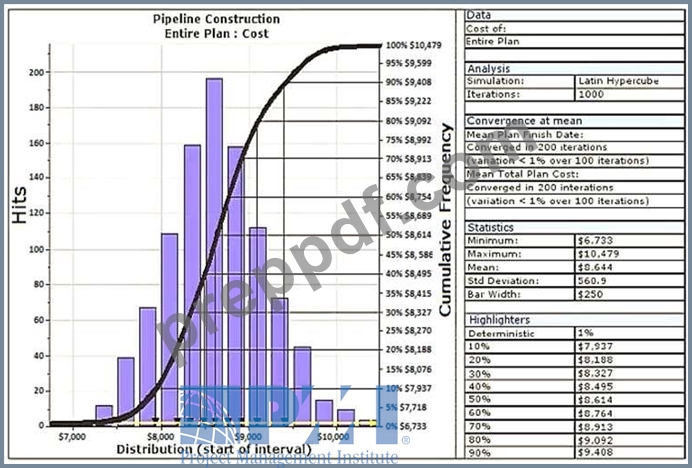
The project values are in thousands. What is the average cost of the project?
- A. US$8,495,000
- B. US$8,614,000
- C. US$8,764,000
- D. US$8,619,000
Answer: B
NEW QUESTION # 65
At an oil and gas company, a major unified management information system is to be implemented. The project manager noted that risks gathered from the organization's business functions are not properly identified and categorized, making it difficult to develop an effective risk response.
How should the project manager handle this situation?
- A. Outsource conducting the risk response plan to risk consultants.
- B. Coach the functional groups on how to properly conduct the process.
- C. Ask functional managers to improve their risk register and process.
- D. Adjust the risk response plans to effectively handle the identified risks.
Answer: B
Explanation:
The project manager should provide guidance and coaching to the functional groups on how to properly identify and categorize risks. This will help improve the quality of the risk register and ensure an effective risk response plan can be developed.
The project manager should coach the functional groups on how to properly conduct the process of identifying and categorizing risks, as this will help to improve the quality and consistency of the risk information and to facilitate the development of an effective risk response plan. The project manager should also provide guidance and support on how to use the appropriate tools and techniques, such as risk breakdown structure, risk taxonomy, risk checklists, risk interviews, and risk workshops, to elicit and document the risks from different perspectives and sources. By coaching the functional groups, the project manager can also enhance their risk awareness and ownership, and foster a collaborative risk culture within the project.
References: The Standard for Risk Management in Portfolios, Programs, and Projects, page 71-72; PMBOK Guide, 6th edition, page 397-398.
NEW QUESTION # 66
Tom is the project manager of the GGG project for his company. He is working with the project team on the Perform Qualitative Risk Analysis process. Tom is having the project team to review the project scope statement as an input to the qualitative risk analysis process. Why?
- A. The project scope statement will reveal the type of project as either a recurrent or first-of-itskind project.
- B. The project scope statement must be reviewed to understand the quality requirements and the risks associated with the demand for quality.
- C. The project scope identifies the risks associated with project constraints.
- D. The project scope statement must be understood to see the project requirements and the inherent risks of the project.
Answer: A
NEW QUESTION # 67
During the project's lifecycle, project risk managers must monitor any risks and address risk responses. What does this level of monitoring consist of?
- A. Provide a numerical estimate of the overall effect of risk on the objectives.
- B. Carry out the agreed risk response action should the risk occur.
- C. Develop the overall risk management strategy for risk integration.
- D. Track identified risks and maintain the viability of response plans.
Answer: D
Explanation:
Monitoring risks during a project's lifecycle involves tracking identified risks and ensuring that response plans remain viable and effective. This continuous monitoring helps ensure that the project is prepared to address risks as they arise and that the risk response strategies remain appropriate as the project progresses. PMI guidelines stress the importance of ongoing risk monitoring to adapt to changes in the project environment and to ensure that the project remains on track to meet its objectives.
NEW QUESTION # 68
A project team has completed the risk response plan for a newly identified major project risk. Some team members argue the plan does not totally eliminate the risk, considering the effort required to implement it, and feel the planned response should be thrown out altogether.
What should the risk manager do in this situation?
- A. All identified risks must be addressed because they might significantly impact the project if they occur.
- B. The response plan should be discontinued and the risk should be accepted and dealt with if it occurs.
- C. Accept the residual risk as it is compatible with the organization's risk appetite.
- D. Accept the response because there are no secondary risks were identified.
Answer: C
NEW QUESTION # 69
A list of risks was identified that could occur during the design phase. Now, the team finished the design phase and those risks did not materialize.
What should the project manager do next?
- A. Remove the risk from the list as they are no longer applicable.
- B. Reevaluate those risks' severity, and update the risk register.
- C. Use their contingency with other risks that are still open.
- D. Close the risks and update their status in the risk register.
Answer: D
Explanation:
Since the design phase is complete and the identified risks did not materialize, the project manager should close the risks and update their status in the risk register.
The project manager should close the risks that did not materialize during the design phase and update their status in the risk register. Closing risks is part of the monitor and close risks process, which involves tracking the implementation of risk responses, monitoring the residual and secondary risks, and evaluating the effectiveness of risk management throughout the project. Closing risks also involves updating the risk register with the current status of the risks, the outcomes of the risk responses, and any lessons learned from the risk management process. Updating the risk register helps to maintain an accurate and updated record of the project risks and their impacts. References: PMI, Project Risk Management, 2nd edition, 2019, p. 97-981
NEW QUESTION # 70
Ted is the project manager of the HRR project for his company. Management has asked that Ted periodically reviews the contingency reserve as risk events happen, pass, or are still pending. What is the purpose of reviewing the contingency reserve?
- A. It helps to evaluate secondary and residual risks related to the risk responses and their costs.
- B. It helps to evaluate if the remaining reserve is adequate for the risk exposure.
- C. It helps to determine how much more funds will need to be invested in the project.
- D. It helps to determine the probability and impact of project risks.
Answer: B
NEW QUESTION # 71
Henry is the project manager of the QBG Project for his company. This project has a budget of $4,576,900 and is expected to last 18 months to complete. The CIO, a stakeholder in the project, has introduced a scope change request for additional deliverables as part of the project work. What component of the change control system would review the proposed changes' impact on the features and functions of the project's product?
- A. Cost change control system
- B. Configuration management system
- C. Scope change control system
- D. Integrated change control
Answer: B
NEW QUESTION # 72
Gary is the project manager of his organization. He is managing a project that is similar to a project his organization completed recently. Gary has decided that he will use the information from
the past project to help him and the project team to identify the risks that may be present in the project. Management agrees that this checklist approach is ideal and will save time in the project. Which of the following statement is most accurate about the limitations of the checklist analysis approach for Gary?
- A. The checklist is also known as top down risk assessment.
- B. The checklist analysis approach only uses qualitative analysis.
- C. The checklist analysis approach saves time, but can cost more.
- D. The checklist analysis approach is fast but it is impossible to build and exhaustive checklist.
Answer: D
NEW QUESTION # 73
You are the project manager for your organization. You have identified a risk event you're your organization could manage internally or externally. If you manage the event internally it will cost your project $578,000 and an additional $12,000 per month the solution is in use. A vendor can manage the risk event for you. The vendor will charge $550,000 and $14,500 per month that the solution is in use. How many months will you need to use the solution to pay for the internal solution in comparison to the vendor's solution?
- A. Approximately 11 months
- B. Approximately 8 months
- C. Approximately 13 months
- D. Approximately 15 months
Answer: A
NEW QUESTION # 74
You are the project manager of a large construction project. Part of the project involves the wiring of the electricity in the building your project is creating. You and the project team determine the electrical work is too dangerous to perform yourself so you hire an electrician to perform the work for the project. This is an example of what type of risk response?
- A. Acceptance
- B. Transference
- C. Mitigation
- D. Avoidance
Answer: B
Explanation:
Explanation
NEW QUESTION # 75
The project risk manager is in the process of identifying risks. The project sponsor has communicated that there is an influential stakeholder who has a senior management position. The other stakeholders do not feel comfortable speaking in front of this stakeholder.
What should the project risk manager do next to identify risks?
- A. Consider the Delphi technique to gather all stakeholder opinions.
- B. Use expert judgment to remove ego or emotional conflict.
- C. Use the brainstorming technique to remove personal bias.
- D. Review the risk breakdown structure to ensure project scope is covered.
Answer: A
Explanation:
The Delphi technique allows the project risk manager to gather opinions from all stakeholders anonymously. This method would enable stakeholders to express their concerns without feeling uncomfortable in front of the influential stakeholder.
The Delphi technique is a tool used to make quick decisions with consensus. This technique consists of sending several sets of anonymous questions to each expert. This is followed by a group discussion after every round. The Delphi technique can help the project risk manager to identify risks by soliciting the opinions of all stakeholders without revealing their identities. This way, the stakeholders can express their views freely and honestly, without being influenced or intimidated by the influential stakeholder. The Delphi technique can also reduce personal bias, ego, or emotional conflict among the participants. The project risk manager can use the results of the Delphi technique to create a list of potential risks and their causes, effects, and probabilities. Reference: 3, 2, 5
NEW QUESTION # 76
You are the project manager for the NHQ Project. This project requires that you install 140 copies of design software onto your department's computers. The vendor offers you a twenty percent discount on the software if your company will purchase 150 or more copies of the software. You communicate this offer with other departments in your firm to see if anyone else would need 10 copies of the software to save your project a significant amount of funds. What is this risk response called?
- A. Transference
- B. Sharing
- C. Exploiting
- D. Avoidance
Answer: B
NEW QUESTION # 77
......
Get ready to pass the PMI-RMP Exam right now using our Project Management Professional Exam Package: https://certkingdom.preppdf.com/PMI/PMI-RMP-prepaway-exam-dumps.html