

NCP-MCI-6.10 Certification Exam Dumps Questions in here [Jun-2026]
Updated NCP-MCI-6.10 Exam Practice Test Questions
Nutanix NCP-MCI-6.10 Exam Syllabus Topics:
| Topic | Details |
|---|---|
| Topic 1 |
|
| Topic 2 |
|
| Topic 3 |
|
| Topic 4 |
|
| Topic 5 |
|
NEW QUESTION # 17
Per organizational requirements, an administrator has uploaded a signed SSL certificate to Prism for Common Access Card (CAC) authentication.
Once the certificate has been uploaded successfully, the certificate appears to be valid but CAC authentication is not functional.
What is a potential cause of this problem?
- A. There is no Certificate Revocation List (CRL) configured.
- B. RSA key size is incorrect.
- C. Online Certificate Status Protocol (OCSP) is not enabled.
- D. Signature Algorithm is incorrect.
Answer: A
NEW QUESTION # 18 
LCM Framework Check
A Lcm prechecks detected 3 issues that would cause upgrade failures.
Check test lacp_configuration' failed: test_lacp_configuration: Unable to find Vcenter details for connection.
Please refer to KB 14277 Check test esx_ha_enabled' failed: Unable to find Vcenter details for connection Check test_es_entering_mm_pinned_vms' failed: Unable to find Vcenter details for connection X LCM Framework Check An administrator is attempting to upgrade the NIC firmware on a Nutanix cluster and sees the error displayed in the exhibit.
Which log is the most appropriate to analyze the LCM precheck failure?
- A. 1cm_wget.out
- B. genesis.out
- C. 1cm_ops.out
- D. catalog.out
Answer: C
Explanation:
The LCM (Life Cycle Manager) precheck failures in this scenario indicate an inability to connect to vCenter to validate ESXi-specific checks, such as LACP configuration, HA, and pinned VMs. The appropriate log to analyze the details of the LCM precheck failures is the 1cm_ops.out log.
From theNutanix Enterprise Cloud Administration (ECA)course materials:
"The 1cm_ops.out log file contains detailed output and error information related to LCM operations, including prechecks, execution, and post-checks. This log is essential for troubleshooting LCM framework failures and understanding the root cause of any issues preventing upgrades."
NEW QUESTION # 19
An administrator is trying toconfigure Metro Availabilitybetween NutanixESXi-based clusters. However, theCompatible Remote Sitesscreen does not list all required storage containers.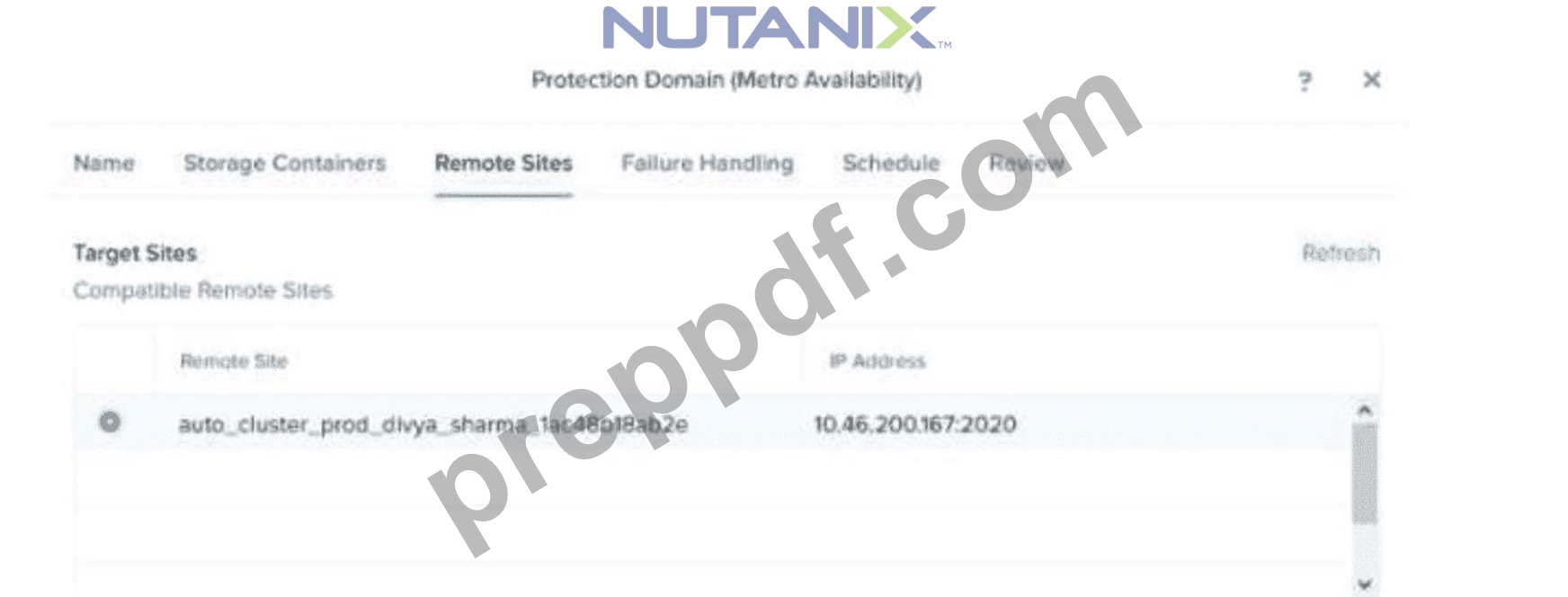
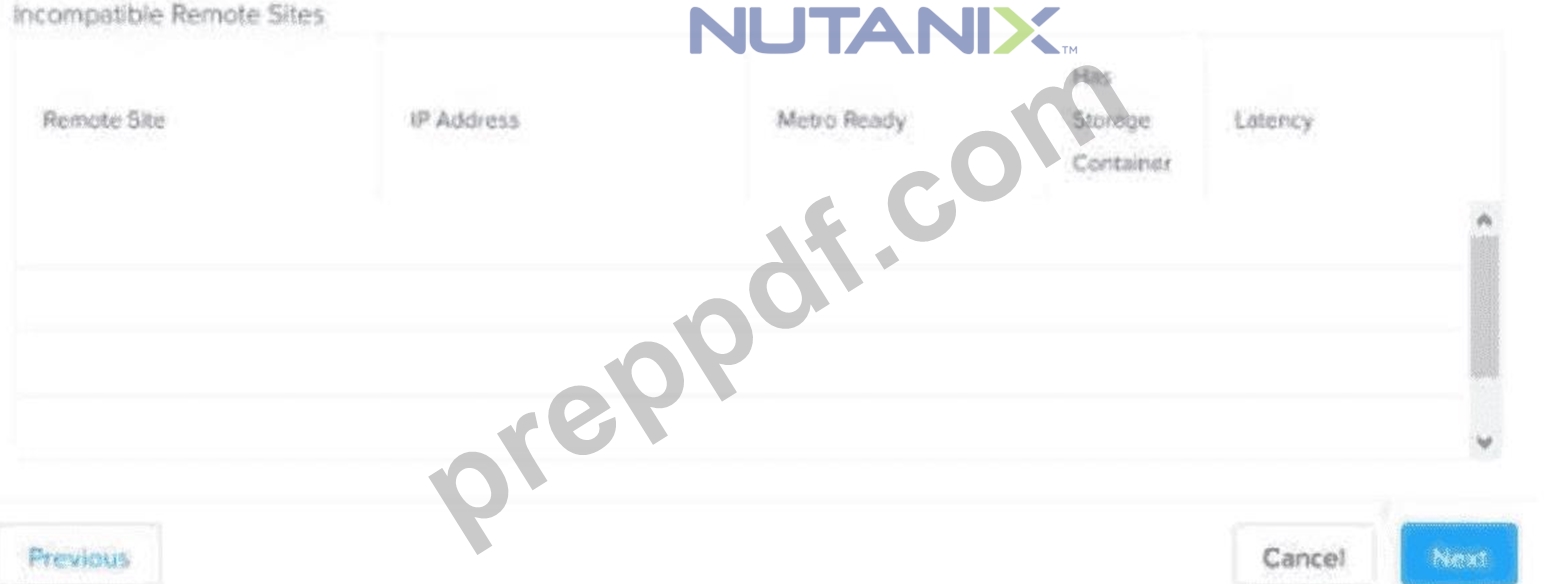
Which two reasons could be a cause for this issue? (Choose two.)
- A. The remote site storage container has compression enabled.
- B. Both storage containers must have the same name.
- C. The destination storage container is not empty.
- D. Source and destination hardware are from different vendors.
Answer: B,C
Explanation:
Metro Availability in Nutanix requires that the primary and secondary storage containers be configured identicallyto ensuredata replication consistency.
Option C (The destination storage container is not empty) is correct:
Theremote storage container must be emptybefore Metro Availability can be enabled.
Existing data can cause conflictsand prevent it from appearing in the "Compatible Remote Sites" list.
Option D (Both storage containers must have the same name) is correct:
Metro Availability requires thatstorage containers have identical names across clusters.
If namesdo not match, thestorage container will not be listed as compatible.
Option A is incorrect: Metro Availability works regardless of hardware vendor differences.
Option B is incorrect:Compression does not affect compatibilitybut may impact performance.
References:
Nutanix Metro Availability Deployment Guide
Nutanix Best Practices forConfiguring Remote Sites for Metro Availability Nutanix KB #Troubleshooting Storage Container Issues in Metro Availability
NEW QUESTION # 20
An administrator wants toenable application discoveryon aNutanix clusterto monitor applications. APrism Central instanceis alreadyconfigured with sufficient CPU and memory.
What other prerequisites must be met before enabling application discovery? (Choose two.)
- A. Sufficient Prism Central VM resources
- B. Network controller is enabled
- C. API key and key ID
- D. Internet connection
Answer: A,D
NEW QUESTION # 21
What is the main function of NearSync Replication in Nutanix?
- A. Replicates data with an RPO of less than 1 minute
- B. Provides synchronous data replication with zero RPO
- C. Backs up VM snapshots to external cloud storage
- D. Migrates workloads between clusters automatically
Answer: A
NEW QUESTION # 22
Due to application requirements, an administrator needs to support a multicast configuration in an AHV cluster.
Which AHV feature can be used to optimize network traffic such that multicast traffic is only forwarded to the VMs that need to receive it?
- A. LACP
- B. IGMP Snooping
- C. LLDP
- D. Network segmentation
Answer: B
Explanation:
Nutanix AHV networking documentation describes IGMP Snooping as a feature that enables the AHV virtual switch to learn which VMs have joined specific multicast groups through IGMP membership reports. The documentation states that with IGMP Snooping enabled, multicast traffic is forwarded only to VMs that are registered members of a multicast group, preventing unnecessary flooding of multicast packets across all ports. LACP is for NIC bonding, network segmentation is for isolating networks, and LLDP is for link layer device discovery. None of these selectively deliver multicast traffic. Only IGMP Snooping provides the optimized multicast forwarding described.
NEW QUESTION # 23
An administrator receives complaints aboutVM performance.
After reviewing theVM's CPU Ready Time data, which step should the administrator take to diagnose the issue further?
- A. Assess cluster SSD capacity.
- B. Enable VM memory oversubscription.
- C. Reviewhost CPU utilization.
- D. Check the number of vCPUs assigned to each CVM.
Answer: C
Explanation:
CPU Ready Time indicates how long a VM waits for CPU resources due to contention.
* Option B (Review host CPU utilization) is correct:
* IfCPU utilization is high, there may beexcessive CPU overcommitment, leading to high CPU Ready Time.
* Adding more hostsorreducing vCPU allocationsmay resolve the issue.
* Option A (Check CVM vCPUs) is incorrect:
* The Controller VM (CVM)does not directly impact application VM performancein this case.
* Option C (Assess SSD capacity) is incorrect:
* CPU Ready Time is unrelated to storage performance.
* Option D (Enable VM memory oversubscription) is incorrect:
* Memory oversubscription does not affect CPU contention.
References:
* Nutanix Prism Central Guide #Troubleshooting VM Performance
* Nutanix KB #Identifying High CPU Ready Time and Solutions
NEW QUESTION # 24
The customer expects to maintain a cluster runway of 9 months. The customer doesn't have a budget for 6 months but they want to add new workloads to the existing cluster.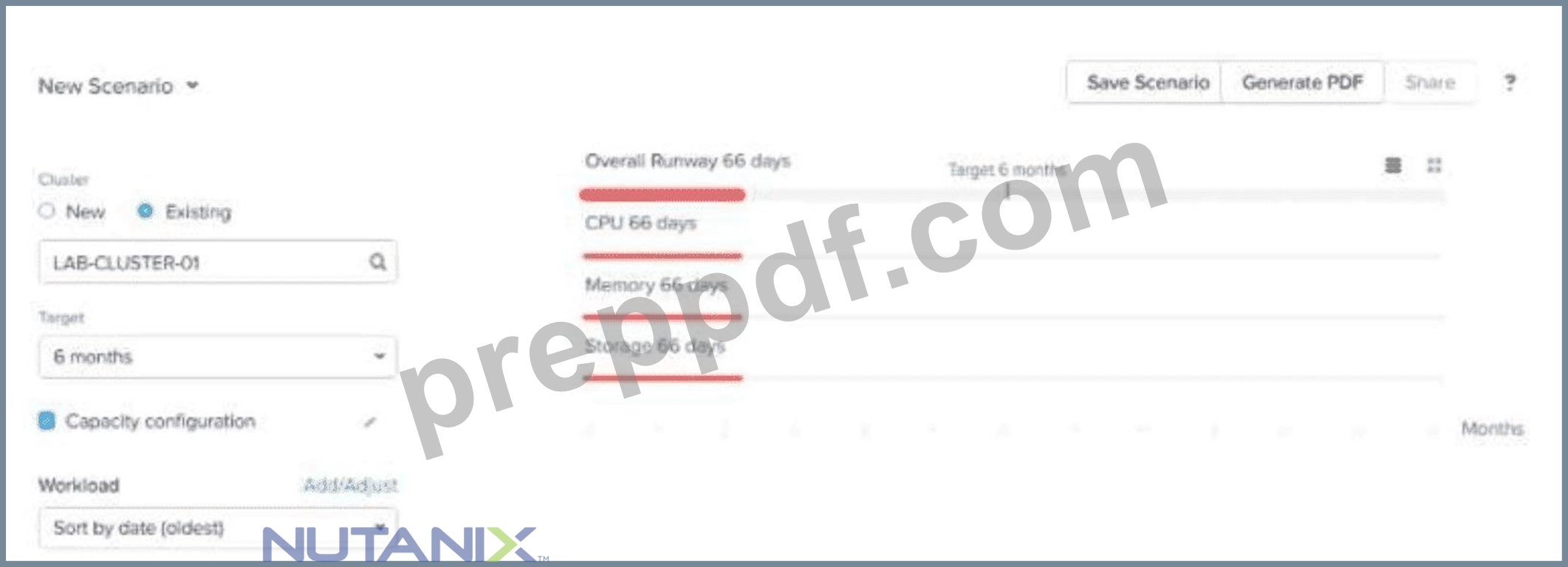
Based on the exhibit, what is required to meet the customer's budgetary timeframe?
- A. Delete workloads running on the cluster.
- B. Add resources to the cluster.
- C. Postpone the start of new workloads.
- D. Change the target to 9 months.
Answer: C
NEW QUESTION # 25
An administrator needs tocreate a storage containerforVM disks. The container must meet the following conditions:
* 10 GiB of the total allocated space must not be used by other containers.
* The container must have a maximum storage capacity of 500 GiB.
What settings should the administrator configure while creating the storage container?
- A. Set Advertised Capacity to 10 GiB.
- B. Set Reserved Capacity to 10 GiB and Advertised Capacity to 500 GiB.
- C. Set Reserved Capacity to 500 GiB.
- D. Set Advertised Capacity to 10 GiB and Reserved Capacity to 500 GiB.
Answer: B
Explanation:
Nutanix storage containers allow administrators to configure capacity reservations and advertised limits for better resource management.
* Option D (Set Reserved Capacity to 10 GiB and Advertised Capacity to 500 GiB) is correct:
* Reserved Capacityensures that10 GiB is always available for this container and not consumed by other containers.
* Advertised Capacitydefines alogical limit of 500 GiBto prevent over-allocation.
* Option A is incorrect:
* Advertised Capacity of 10 GiB is too lowand does not match the requirement of a500 GiB storage container.
* Option B is incorrect:
* Only setting Advertised Capacity does not guarantee Reserved Capacity, meaning other containers could consume the reserved space.
* Option C is incorrect:
* Setting only Reserved Capacity does not enforce an upper limit, which could lead to overprovisioning.
References:
Nutanix Storage Management Guide#Understanding Storage Container Settings Nutanix KB#Advertised vs. Reserved Capacity in Storage Containers
NEW QUESTION # 26
The administrator sees an alert stating that the "nutanix" user should not be allowed to SSH to the CVM using a password.
What should the administrator do to ensure the nutanix user can no longer SSH to a CVM using a password?
- A. Block port 22 on the CVM firewall
- B. Rename the user
- C. Enable Cluster Lockdown
- D. Delete the nutanix user
Answer: C
Explanation:
The "nutanix" user is a system-level account required by the platform for internal operations, automation, cluster communication, and support access. It cannot be deleted or renamed. Nutanix security guidelines state:
"The correct method to prevent password-based SSH access for system accounts is to use Cluster Lockdown mode, which disables password authentication and enforces key-based access for all system-level CVM accounts." Cluster Lockdown modifies SSH configuration across all CVMs, ensuring:
* password authentication is disabled
* only key-based authentication is permitted
* privileged system accounts such as 'nutanix' cannot log in interactively Blocking port 22 is not appropriate because it would block SSH entirely, including legitimate administrative access. The "nutanix" user cannot be renamed or removed due to system dependency.
Thus, enabling Cluster Lockdown is the proper Nutanix-approved method to remove password-based SSH access for system accounts.
NEW QUESTION # 27
Which feature in Nutanix AHV provides network microsegmentation to enhance VM security?
- A. vSwitch
- B. Nutanix Prism
- C. Acropolis SDN
- D. Flow
Answer: D
NEW QUESTION # 28
An administrator has been tasked with performing firmware upgrades for all their Nutanix sites.
When attempting to perform firmware upgrades via Life Cycle Manager (LCM) at a remote site with a single- node cluster deployed, no firmware updates are listed as being available. The administrator confirmed the currently installed firmware is several revisions behind.
Why are there no firmware upgrades listed in LCM for this cluster?
- A. LCM cannot perform firmware upgrades on single-node clusters.
- B. Single-node clusters only support one-click firmware upgrades.
- C. LCM does not have access to the internet.
- D. LCM is not supported on single-node clusters.
Answer: A
Explanation:
Nutanix LCM architecture supports firmware, BIOS, BMC, disk controller, and drive updates only when the environment includes multiple nodes that can provide redundancy during the upgrade process. The LCM documentation specifies that firmware upgrades require node evacuation and rolling upgrade sequencing so that workloads remain available. A single-node cluster does not have node-level redundancy and therefore cannot support firmware upgrade operations that require putting a node into maintenance automatically. The guidance clearly states that "firmware upgrades are not supported for single-node clusters because the host cannot be safely placed into a maintenance mode during the LCM workflow." LCM is supported for software inventory, but not for firmware activation on single-node clusters. This explains why no firmware updates appear in the LCM interface.
NEW QUESTION # 29
In Prism Element, how many nodes can be placed into maintenance mode at one time on 12-node FT2 cluster?
- A. 0
- B. 1
- C. 2
- D. 3
Answer: D
Explanation:
In a 12-node FT2 cluster, onlyonenode can be placed into maintenance mode at a time. This ensures that the cluster maintains data redundancy and protection (FT2 indicates 2-failure tolerance).
From theNutanix Enterprise Cloud Administration (ECA)course materials:
"For FT2 clusters, a maximum of one node can be placed in maintenance mode at a time to ensure the cluster' s ability to tolerate failures and maintain quorum."
NEW QUESTION # 30
In a scale-out Prism Central deployment, what additional functionality does configuring an FQDN instead of a Virtual IP provide?
- A. Resiliency
- B. SSL Certificate
- C. Segmentation
- D. Load balancing
Answer: D
Explanation:
Scale-out Prism Central deployments consist of multiple nodes running the Prism Central service. Nutanix documentation emphasizes that:
"When deploying multi-node Prism Central, an FQDN backed by DNS can provide request distribution across all Prism Central nodes, enabling load balancing and increased concurrency." A Virtual IP in contrast only directs traffic to a single active Prism Central node. Internal behavior notes:
* "A VIP is not active-active; it designates one node as primary for all inbound requests."
* "Using an FQDN with DNS round-robin or an external load balancer allows the cluster to distribute workload across all PC nodes." The FQDN allows:
* distributing API/UI traffic across multiple Prism Central nodes
* improving performance under heavy load
* enabling parallel query handling
* avoiding bottlenecks on the primary node
SSL certificates apply to either VIP or FQDN. Segmentation and resiliency are unrelated to FQDN usage.
Thus, the correct answer is Load Balancing.
NEW QUESTION # 31
An administrator has been tasked with performingfirmware upgradesfor all Nutanix sites.
When attempting to performfirmware upgrades via Life Cycle Manager (LCM)at aremote site with a single- node cluster, no firmware updates are listed as available. The administrator confirmed that the currently installed firmware isseveral revisions behind.
Why are no firmware upgrades listed in LCM for this cluster?
- A. LCM cannot perform firmware upgrades on single-node clusters.
- B. LCM does not have connectivity to the internet.
- C. LCM is not supported on single-node clusters.
- D. Single-node clusters only support one-disk firmware upgrades.
Answer: A
Explanation:
The Nutanix Life Cycle Manager (LCM) is designed to manage and automate firmware and software upgrades across Nutanix clusters. However, firmware upgrades via LCM are not supported for single-node clusters. This limitation is documented in the ECA course as well as in LCM's official release notes and guides.
From the Nutanix Enterprise Cloud Administration (ECA) course materials:
"LCM does not support performing firmware upgrades on single-node clusters. These clusters require manual upgrades, and LCM will not list any available firmware updates for them, regardless of the firmware revision state." The other options:
* A is incorrect; single-node clusters don't have this limitation specifically for "one-disk" firmware upgrades-it's a complete limitation for all firmware tasks in LCM.
* B is misleading; LCM is supported in general for Nutanix clusters, just not for firmware tasks in single- node clusters.
* D is incorrect because lack of internet connectivity would typically show an error related to download or connectivity issues, not complete absence of firmware updates.
NEW QUESTION # 32
Refer to Exhibit: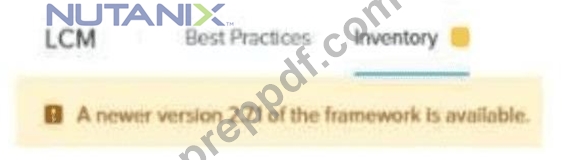
An administrator notices the message shown in the exhibit when navigating to LCM from Prism Central.
Which action should the administrator take to update LCM to the latest version?
- A. Perform anInventory Scan.
- B. Run anAOS upgrade.
- C. Download and install the latest LCM version from a CVM.
- D. Run anAHV upgrade.
Answer: A
Explanation:
When Life Cycle Manager (LCM) reports thata newer framework version is available, thecorrect actionis toperform an inventory scan (Option C).
* Performing an inventory scan updates the available firmware/software versionsand allows LCM to download required updates.
* Option A (Run an AOS upgrade)is unrelated to the LCM framework update process.
* Option B (Run an AHV upgrade)is a separate component update and does not affect the LCM framework.
* Option D (Download manually from a CVM)is not necessary because LCM updates are automatically pulled after an inventory scan.
References:
Nutanix LCM User Guide #Updating LCM Framework and Performing Inventory Scans Nutanix KB #Best Practices for LCM Updates Nutanix Prism Central #LCM Update Workflow
NEW QUESTION # 33
An administrator is trying to troubleshoot the environment after NCC raised an alert:
Detailed information for remote_site_connectivity_check: Node x.x.x.x:
WARN: Failed to connect to the remote site <remote_site>.
Which two steps should an administrator follow to provide a solution? (Choose two.)
- A. Configure Network Address Translation performed by any device in between the two Nutanix clusters.
- B. Confirm that the remote cluster is reachable, and ports 2009 and 2020 are open between the clusters.
- C. If the remote site has been re-configured and the cluster has a new cluster incarnation ID, re-create the remote site.
- D. Check if ping packets with an MTU of 9000 reach the destination cluster.
Answer: B,C
Explanation:
The NCC alert indicates connectivity failure to the remote site. Resolving this involves confirming network connectivity and re-establishing the remote site configuration if necessary.
From theNutanix Enterprise Cloud Administration (ECA)course materials:
"The primary ports used for replication between clusters are 2009 (for Prism Element API) and 2020 (for data replication). Ensuring these ports are open and reachable is critical for remote site connectivity." Also:
"If the remote site has been re-imaged or reconfigured, it may have a new cluster incarnation ID. In such cases, the remote site configuration must be recreated to align with the current cluster information." Steps like checking ping with MTU 9000 (D) are not directly related to remote site connectivity for replication, and NAT configurations (B) are generally not recommended unless explicitly required.
NEW QUESTION # 34
A user created areportin theIntelligent Operations Analysis Dashboardbut forgot to download it. However, after logging back into Prism Central, the administrator finds that thereport is no longer available.
What is the most likely cause?
- A. Reports areautomatically deleted after 24 hours.
- B. Theuser-generated report was archived.
- C. A user withCluster Viewer role deleted the report.
- D. Thereport is stored in the cluster's Prism Element.
Answer: A
Explanation:
In Nutanix Prism Central, user-generated reports in Intelligent Operations are stored for a limited time and then deleted automatically.
* Option C (Reports are automatically deleted after 24 hours) is correct:
* Reportsdo not persist indefinitelyunless they arescheduled reports.
* One-time reports expire after 24 hours.
* Option A (Cluster Viewer deleted the report) is incorrect:
* Cluster Viewerdoes not have permissions to delete reports.
* Option B (Report was archived) is incorrect:
* Nutanixdoes not automatically archive reports.
* Option D (Report stored in Prism Element) is incorrect:
* Reportsare generated and stored only in Prism Central, not Prism Element.
References:
Nutanix Prism Central Guide #Intelligent Operations & Report Retention Policies Nutanix KB #Why Reports in Prism Central Are Not Persisting
NEW QUESTION # 35
An administrator started an LCM upgrade of the AHV hosts and realized that the upgrades will continue beyond their planned maintenance window.
Which feature should be leveraged to prevent additional updates from occurring?
- A. Run the .py script
- B. Restart genesis on the cluster to restart the LCM service
- C. Use the Stop Update feature in LCM
- D. Cancel the LCM tasks via the Ergon command line (ecli)
Answer: C
Explanation:
Nutanix Life Cycle Manager (LCM) has built-in workflow controls that allow administrators to pause or stop active upgrade sessions. The documentation states:
"Administrators can use the Stop Update option in the LCM UI to halt further job progression. This safely stops the upgrade pipeline without disrupting already-applied updates." More internal behavior details:
* Stop Update immediately prevents LCM from starting additional node or component upgrades.
* It safely terminates queue execution while maintaining cluster consistency.
* It does not require command-line interaction or service restarts.
Using .py scripts is not recommended and is reserved for engineering workflows. Restarting Genesis or canceling tasks via ecli may interrupt LCM activities but do not cleanly stop the scheduled upgrade workflow.
The supported and correct control method is the built-in Stop Update button.
NEW QUESTION # 36
Refer to Exhibit: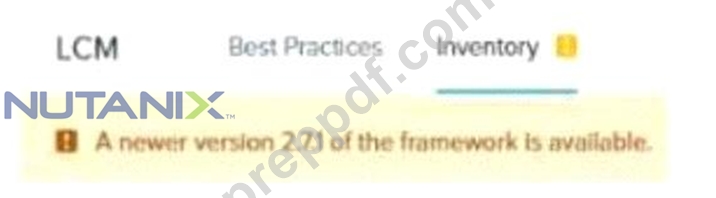
An administrator notices the message shown in the exhibit when navigating to LCM from Prism Central.
Which action should the administrator take to update LCM to the latest version?
- A. Perform anInventory Scan.
- B. Run anAOS upgrade.
- C. Download and install the latest LCM version from a CVM.
- D. Run anAHV upgrade.
Answer: A
Explanation:
When Life Cycle Manager (LCM) reports thata newer framework version is available, thecorrect actionis toperform an inventory scan (Option C).
* Performing an inventory scan updates the available firmware/software versionsand allows LCM to download required updates.
* Option A (Run an AOS upgrade)is unrelated to the LCM framework update process.
* Option B (Run an AHV upgrade)is a separate component update and does not affect the LCM framework.
* Option D (Download manually from a CVM)is not necessary because LCM updates are automatically pulled after an inventory scan.
References:
* Nutanix LCM User Guide #Updating LCM Framework and Performing Inventory Scans
* Nutanix KB #Best Practices for LCM Updates
* Nutanix Prism Central #LCM Update Workflow
NEW QUESTION # 37
Which prerequisite should be met before any LCM updates are performed?
- A. Update BIOS
- B. Update AHV
- C. Update AOS
- D. Update Foundation
Answer: C
Explanation:
Before performing any LCM (Life Cycle Manager) updates on a Nutanix cluster, it is essential to ensure that the AOS (Acropolis Operating System) is updated to the required or recommended version. AOS updates provide foundational enhancements, security patches, and compatibility improvements, which are critical for the successful execution of LCM updates.
From theNutanix Enterprise Cloud Administration (ECA)course materials:
"LCM updates depend on the underlying AOS version. Before proceeding with any hardware or software updates through LCM, administrators must ensure that the cluster is running a supported AOS version. This step ensures compatibility and prevents issues that can arise from dependencies between AOS and the update components." Additionally:
"AOS upgrades should be performed first to bring the cluster to a version that supports the desired LCM updates for components like BIOS, firmware, and hypervisors. This aligns the management stack with the latest features and security enhancements." Therefore, updating AOS before performing LCM updates is a mandatory prerequisite to ensure stability and supportability for the entire cluster lifecycle management process.
NEW QUESTION # 38
Which task should be performed first when upgrading host memory?
- A. Execute "shutdown -h now" from the AHV command line interface.
- B. Remove node from the cluster.
- C. Gracefully stop the host by using the out of band management interface.
- D. Place node into the maintenance mode
Answer: D
Explanation:
The Nutanix ECA course provides detailed procedures for performing hardware upgrades, such as adding host memory, to ensure cluster stability and data availability. Upgrading host memory requires safely preparing the node to avoid disrupting running VMs or cluster operations.
Extract from Nutanix Enterprise Cloud Administration (ECA) Course Documents:
Module: Cluster Management, Section: Hardware Upgrades"Before performing hardware upgrades, such as adding host memory, the node must be placed into maintenance mode. This ensures that all VMs are migrated to other nodes and the host is safely isolated from cluster operations." Module: Host Maintenance, Section: Maintenance Mode"Placing a node into maintenance mode is the first step for hardware upgrades. Maintenance mode migrates all VMs to other nodes, stops the Controller VM (CVM), and prepares the host for safe shutdown or hardware changes." Explanation of Options:
A). Gracefully stop the host by using the out of band management interfaceThis is incorrect. Stopping the host via the out-of-band management interface (e.g., IPMI or iLO) without first entering maintenance mode risks disrupting running VMs and cluster services. The ECA course warns:"Shutting down a host without maintenance mode can cause VM crashes and data unavailability, as VMs are not migrated." B). Remove node from the clusterThis is incorrect. Removing a node from the cluster is a permanent action that detaches it from the cluster's metadata and storage pool, requiring re-imaging to rejoin. It is not appropriate for a temporary hardware upgrade like adding memory. The ECA course states:"Removing a node is not required for hardware upgrades and should be avoided, as it disrupts cluster configuration." C). Execute "shutdown -h now" from the AHV command line interfaceThis is incorrect. Running shutdown -h now on the AHV host without entering maintenance mode will abruptly stop the host, potentially crashing VMs and disrupting cluster operations. The ECA course notes:"Directly shutting down a host via CLI without maintenance mode risks data loss and service disruption." D). Place node into maintenance modeThis is the correct answer. Placing the node into maintenance mode is the first step for hardware upgrades, as it safely migrates all VMs to other nodes, stops the CVM, and prepares the host for shutdown or hardware changes. The ECA course emphasizes that maintenance mode ensures cluster stability during upgrades.
Supporting Extract:"To upgrade host memory, place the node into maintenance mode using Prism Element or the CLI command ncli host maintenance_mode. This ensures safe VM migration and host isolation." Additional Context from ECA:
Maintenance Mode Process: In Prism Element, maintenance mode can be enabled underHardware > Host > Enter Maintenance Mode. The process automatically migrates VMs using live migration, stops the CVM, and isolates the host. For AHV, the CLI command is ncli host maintenance_mode id=<host_id> enable=true.
Memory Upgrade: After entering maintenance mode, the host can be safely powered off to add memory, then powered back on and exited from maintenance mode.
Supporting Reference from Web Results:
The Nutanix Bible (https://www.nutanix.com/go/the-nutanix-bible) confirms:"Maintenance mode is the required first step for host hardware upgrades, ensuring VMs are migrated and the node is isolated before changes like memory upgrades."
NEW QUESTION # 39
......
Pass NCM-MCI NCP-MCI-6.10 Exam With 176 Questions: https://certkingdom.preppdf.com/Nutanix/NCP-MCI-6.10-prepaway-exam-dumps.html