

Free HP HPE7-A01 Exam 2026 Practice Materials Collection
HPE7-A01 Exam Info and Free Practice Test All-in-One Exam Guide Mar-2026
Becoming an Aruba Certified Campus Access Professional through the HPE7-A01 exam provides a range of benefits to IT professionals. First, it validates their expertise in Aruba wireless technologies, which is highly sought after by organizations looking to deploy or enhance their wireless networks. Additionally, certified professionals can expect to earn higher salaries and receive more job opportunities than their non-certified counterparts. Finally, obtaining the HPE7-A01 certification demonstrates a commitment to ongoing learning and professional development in the field of wireless networking.
HPE7-A01 certification exam is an online, proctored exam that consists of 60 multiple-choice questions. Candidates will have 90 minutes to complete the exam, and the passing score is 70%. HPE7-A01 exam fee is $200, and it can be taken at any time from any location. Candidates who pass the exam will receive the Aruba Certified Campus Access Professional (ACCP) certification, which is valid for three years.
NEW QUESTION # 25
A new network design is being considered to minimize client latency in a high-density environment. The design needs to do this by eliminating contention overhead by dedicating subcarriers to clients.
Which technology is the best match for this use case?
- A. MU-MIMO
- B. QWMM
- C. Channel Bonding
- D. OFDMA
Answer: D
Explanation:
Explanation
OFDMA (Orthogonal Frequency Division Multiple Access) is a technology that can minimize client latency in a high-density environment by eliminating contention overhead by dedicating subcarriers to clients. OFDMA allows multiple clients to transmit simultaneously on different subcarriers within the same channel, reducing contention and increasing efficiency. MU-MIMO (Multi-User Multiple Input Multiple Output) is a technology that allows multiple clients to transmit simultaneously on different spatial streams within the same channel, but it does not eliminate contention overhead. QWMM (Quality of Service Wireless Multimedia) is a technology that prioritizes traffic based on four access categories, but it does not eliminate contention overhead. Channel Bonding is a technology that combines two adjacent channels into one wider channel, increasing bandwidth but not eliminating contention overhead. References:
https://www.arubanetworks.com/assets/ds/DS_AP510Series.pdf
https://www.arubanetworks.com/assets/wp/WP_WiFi6.pdf
NEW QUESTION # 26
You must ensure the HPEAruba network you are configuring for a client is capable of plug-and-play provisioning of access points. What enables this capability?
- A. SRTP
- B. CSMA
- C. LLDP-MED
- D. UCC Service
Answer: D
Explanation:
The capability that enables plug-and-play provisioning of access points in an HPE Aruba network is the UCC Service. The UCC Service is a cloud-based service that allows the access points to automatically discover and connect to the Aruba Central management platform without any manual intervention. The UCC Service also provides zero-touch configuration, firmware updates, and monitoring for the access points1.
The other options are incorrect because:
B) LLDP-MED: LLDP-MED is a protocol that enhances the interoperability between network devices and IP phones. It does not enable plug-and-play provisioning of access points2.
C) SRTP: SRTP is a protocol that provides encryption and authentication for voice and video traffic. It does not enable plug-and-play provisioning of access points3.
D) CSMA: CSMA is a protocol that regulates how devices share a common medium, such as a wireless channel. It does not enable plug-and-play provisioning of access points.
NEW QUESTION # 27
You are doing tests in your lab and with the following equipment specifications:
- AP1 has a radio that generates a 20 dBm signal
- AP2 has a radio that generates a 8 dBm signal
- AP1 has an antenna with a gain of 7 dBI.
- AP2 has an antenna with a gain of 12 dBI.
- The antenna cable for AP1 has a 3 dB loss
- The antenna cable for AP2 has a 3 dB loss.
What would be the calculated Equivalent Isotropic Radiated Power (EIRP) for AP1?
- A. 8 dBm
- B. 22 dBm
- C. 2 dBm
- D. 24 dBm
Answer: D
Explanation:
To calculate the Equivalent Isotropic Radiated Power (EIRP), you use the following formula:
EIRP = Transmit Power + Antenna Gain - Cable Loss
For AP1, the values are:
Transmit Power = 20 dBm
Antenna Gain = 7 dBi
Cable Loss = 3 dB
NEW QUESTION # 28
You are setting up a customer's 15 headless loT devices that do not support 802.1X. What should you use?
- A. Clearpass with WPA3-PSK
- B. Multiple Pre-Shared Keys (MPSK) Local
- C. Clearpass with WPA3-AES
- D. Multiple Pre-Shared Keys (MPSK) with WPA3-AES
Answer: B
Explanation:
MPSK Local is a feature that can be used to set up 15 headless IoT devices that do not support 802.1X authentication. MPSK Local allows the switch to automatically generate and assign unique pre-shared keys for devices based on their MAC addresses, without requiring any configuration on the devices or an external authentication server. The other options are incorrect because they either require 802.1X authentication, which is not supported by the IoT devices, or WPA3 encryption, which is not supported by Aruba CX switches.
References:
https://www.arubanetworks.com/techdocs/AOS-CX/10.04/HTML/5200-6728/bk01-ch05.htmlhttps://www.aruba
NEW QUESTION # 29
Your customer is interested in hearing more about how roles can help keep consistent policy enforcement in a distributed overlay fabric How would you explain this concept to them''
- A. Group Based Policy ID is applied on ingress VTEP after device authentication and policy is enforced on egress VTEP
- B. Group Based Policy ID is applied on egress VTEP after device authentication and policy is enforced on ingress VTEP
- C. Role-based policies enhance User Based Tunneling across the campus network and the policy traffic is protected with iPsec
- D. Role-based policies are tied to IP addresses which have an advantage over IP-based policies and role names are sent between VTEPs
Answer: A
Explanation:
This is the correct explanation of how roles can help keep consistent policy enforcement in a distributed overlay fabric. Roles are used to assign group based policy IDs (GBPs) to devices after they authenticate with ClearPass or a local database. GBPs are then used to tag the traffic from the devices and send them to the ingress VTEP, which applies the GBP on the VXLAN header. The egress VTEP then enforces the policy based on the GBP and the destination device. The other options are incorrect because they either do not describe the correct sequence of events or do not use the correct terms. References: https://www.
arubanetworks.com/techdocs/AOS-CX/10.04/HTML/5200-6728/bk01-ch03.html https://www.arubanetworks.
com/techdocs/AOS-CX/10.04/HTML/5200-6728/bk01-ch05.html
NEW QUESTION # 30
Drag and Drop Question
Match the solution components of HPE Aruba Networking Central NetConductor (Options may be used more than once or not at all.)
Answer:
Explanation:
NEW QUESTION # 31
What are two advantages of splitting a larger OSPF area into a number of smaller areas? (Select two)
- A. It increases stability
- B. it simplifies the configuration.
- C. It reduces processing overhead.
- D. It extends the LSDB
- E. It reduces the total number of LSAs
Answer: A,C
Explanation:
Splitting a larger OSPF area into a number of smaller areas has several advantages for network scalability and performance. Some of these advantages are:
* It increases stability by limiting the impact of topology changes within an area. When a link or router fails in an area, only routers within that area need to run the SPF algorithm and update their routing tables. Routers in other areas are not affected by the change and do not need to recalculate their routes.
* It reduces processing overhead by reducing the size and frequency of link-state advertisements (LSAs).
LSAs are packets that contain information about the network topology and are flooded within an area. By dividing a network into smaller areas, each area has fewer LSAs to generate, store, and process,
* which saves CPU and memory resources on routers.
* It reduces bandwidth consumption by reducing the amount of routing information exchanged between areas. Routers that connect different areas, called area border routers (ABRs), summarize the routing information from one area into a single LSA and advertise it to another area. This reduces the number of LSAs that need to be transmitted across area boundaries and saves network bandwidth.
NEW QUESTION # 32
The customer needs a network hardware refresh to replace an aging Aruba 5406R core switch pair using spanning tree configuration with Aruba CX 8360-32YC switches What is the benefit of VSX clustering with the new solution?
- A. dual control plane provides better resiliency
- B. dual Aruba AP LAN port connectivity for PoE redundancy
- C. faster MSTP converge processing
- D. stacked data-plane
Answer: A
Explanation:
VSX clustering is a feature that allows two Aruba CX switches to operate as a single logical device, providing high availability, scalability, and simplified management. VSX clustering has several benefits over spanning tree configuration, such as:
* Dual control plane provides better resiliency. Unlike stacking, where switches share a single control plane, VSX switches have independent control planes that synchronize their states over an inter-switch link (ISL). This means that if oneswitch fails or reboots, the other switch can continue to operate without affecting traffic flows or network services.
* Active-active forwarding provides better performance. Unlike spanning tree, where some links are blocked to prevent loops, VSX switches use all available links for forwarding traffic, providing load balancing and increased bandwidth utilization.
* Multichassis LAG provides better redundancy. Unlike single-chassis LAG, where all member ports belong to one switch, VSX switches can form multichassis LAGs with downstream or upstream devices, where member ports are distributed across both switches. This provides link redundancy and seamless failover in case of switch or port failure.
References: https://www.arubanetworks.com/assets/tg/TG_VSX.pdf
NEW QUESTION # 33
Which network components communicate using the RADIUS protocol for authentication and accounting?
- A. an access point and the endpoint device
- B. an endpoint device and a RADIUS authentication server
- C. a Network Access Server and a RADIUS authentication server
- D. a Network Access Server and an endpoint device
Answer: C
NEW QUESTION # 34
What is a primary benefit of BSS coloring?
- A. BSS color tags improve security by identifying rogue APs and removing them from the network.
- B. BSS color tags are applied to client devices and can reduce the threshold for interference
- C. BSS color tags improve performance by allowing clients on the same channel to share airtime.
- D. BSS color tags are applied to Wi-Fi channels and can reduce the threshold for interference
Answer: D
Explanation:
Explanation
BSS coloring is a mechanism that helps identify the BSS Basic Service Set. A BSS is a set of interconnected stations that can communicate with each other. BSS can be an independent BSS or infrastructure BSS. An independent BSS is an ad hoc network that does not include APs, whereas the infrastructure BSS consists of an AP and all its associated clients. on the same channel and differentiate them from other BSS on the same channel12. Each BSS is assigned a color code, which is a 6-bit value that is carried in the PHY header of the Wi-Fi frames12. By using BSS coloring, the APs and clients can reduce the threshold for interference detection and avoid unnecessary backoff or retransmissions when they detect frames from other BSS with different colors12. This can improve the spectral efficiency and throughput of the network12. The other options are incorrect because they do not describe the primary benefit of BSS coloring.
NEW QUESTION # 35
Describe the difference between Class of Service (CoS) and Differentiated Services Code Point (DSCP).
- A. CoS is only contained in VLAN Tag fields DSCP is in the IP Header and preserved throughout the IP packet flow
- B. They are similar and can be used interchangeably.
- C. CoS has much finer granularity than DSCP
- D. CoS is only used to determine CLASS of traffic DSCP is only used to differentiate between different Classes.
Answer: A
Explanation:
CoS and DSCP are both methods of marking packets for quality of service (QoS) purposes. QoS is a mechanism that allows network devices to prioritize and differentiate traffic based on certain criteria, such as application type, source, destination, etc. CoS stands for Class of Service and is a 3-bit field in the 802.1Q VLAN tag header. CoS can only be used on Ethernet frames that have a VLAN tag, and it can only be preserved within a single VLAN domain. DSCP stands for Differentiated Services Code Point and is a 6-bit field in the IP header. DSCP can be used on any IP packet, regardless of the underlying layer 2 technology, and it can be preserved throughout the IP packet flow, unless it is modified by intermediate devices.
References: https://www.cisco.com/c/en/us/td/docs/ios-xml/ios/qos/configuration/15-mt/qos-15-mt-book/qos-overview.html https://www.cisco.com/c/en/us/support/docs/lan-switching/8021q/17056-741-4.html
https://www.cisco.com/c/en/us/support/docs/quality-of-service-qos/qos-packet-marking/10103-dscpvalues.html
NEW QUESTION # 36
A customer is looking Tor a wireless authentication solution for all of their loT devices that meet the following requirements
- The wireless traffic between the IoT devices and the Access Points must be encrypted
- Unique passphrase per device
- Use fingerprint information to perform role-based access
Which solutions will address the customer's requirements? (Select two.)
- A. ClearPass Policy Manager
- B. Local User Derivation Rules
- C. MPSK Local with EAP-TLS
- D. MPSK and an internal RADIUS server
- E. MPSK Local with MAC Authentication
Answer: A,C
Explanation:
The correct answers are C and D.
MPSK (Multi Pre-Shared Key) is a feature that allows multiple PSKs to be used on a single SSID, providing device-specific or group-specific passphrases for enhanced security and deployment flexibility for headless IoT devices1. MPSK requires MAC authentication against a ClearPass Policy Manager server, which returns the encrypted passphrase for the device in a RADIUS VSA2. ClearPass Policy Manager is a platform that provides role- and device-based network access control for any user across any wired, wireless and VPN infrastructure3. ClearPass Policy Manager can also use device profiling and posture assessment to assign roles based on device fingerprint information4.
MPSK Local is a variant of MPSK that allows the user to configure up to 24 PSKs per SSID locally on the device, without requiring ClearPass Policy Manager5. MPSK Local can be combined with EAP-TLS (Extensible Authentication Protocol-Transport Layer Security), which is a secure authentication method that uses certificates to encrypt the wireless traffic between the IoT devices and the access points6. EAP-TLS can also use device certificates to perform role-based access control6.
Therefore, both ClearPass Policy Manager and MPSK Local with EAP-TLS can meet the customer's requirements for wireless authentication, encryption, unique passphrase, and role-based access for their IoT devices.
MPSK and an internal RADIUS server is not a valid solution, because MPSK does not support internal RADIUS servers and requires ClearPass Policy Manager789. MPSK Local with MAC Authentication is not a valid solution, because MAC Authentication does not encrypt the wireless traffic or use fingerprint information for role-based access2. Local User Derivation Rules are not a valid solution, because they do not provide unique passphrase per device or use fingerprint information for role-based access101112.
NEW QUESTION # 37
A customer is using stacked Aruba CX 6200 and CX 6300 switches for access and a VSX pair of Aruba CX
8325 as a collapsed core 802 1X is implemented for authentication. Due to the lack of cabling, some unmanaged switches are still in use Sometimes devices behind these switches cause network outages The switch should send a warning to the helpdesk when the problem occurs You have been asked to implement an effective solution to the problem What is the solution for this?
- A. Configure spanning tree on the Aruba CX 8325 switches Set the trap-option
- B. Configure loop protection on all edge ports of the Aruba CX 6200 and CX 6300 switches Set up the trap-option
- C. Configure loop protection on all edge ports of the Aruba CX 6200 and CX 6300 switches No trap option is needed
- D. Configure spanning tree on the Aruba CX 6200 and CX 6300 switches No trap option is needed
Answer: B
Explanation:
This is the correct solution to the problem of devices behind unmanaged switches causing network outages due to loops. Loop protection is a feature that allows an Aruba CX switch to detect and prevent loops by sending loop protection packets on each port, LAG, or VLAN on which loop protection is enabled. If a loop protection packet is received by the same switch that sent it, it indicates a loop exists and an action is taken based on the configuration. Loopprotection should be configured on all edge ports of the Aruba CX 6200 and CX 6300 switches, which are the ports that connect to end devices or unmanaged switches. The trap-option should be set up to send a warning to the helpdesk when a loop is detected. The other options are incorrect because they either do not configure loop protection or do not set up the trap-option. References:
https://www.arubanetworks.com/techdocs/AOS-CX/10.05/HTML/5200-7540/GUID-99A8B276-0DA3-4458-AF
https://www.arubanetworks.com/techdocs/AOS-CX/10.05/HTML/5200-7540/GUID-D8613BDE-CD21-4B83-85
NEW QUESTION # 38
A large retail client is looking to generate a rich set of contextual data based on the location information of wireless clients in their stores Which standard uses Round Trip Time (RTT) and Fine Time Measurements (FTM) to calculate the distance a client is from an AP?
- A. 802.11ah
- B. 802.11V
- C. 802.11mc
- D. 802.11be
Answer: C
Explanation:
802.11mc is a standard that uses Round Trip Time (RTT) and Fine Time Measurements (FTM) to calculate the distance a client is from an AP. 802.11mc defines a protocol for exchanging FTM frames between an AP and a client, which contain timestamps that indicate when the frames were transmitted and received. By measuring the RTT of these frames, the AP or the client can estimate their distance based on the speed of light. The other options are incorrect because they either do not use RTT or FTM or do not exist as standards.References:
https://www.arubanetworks.com/assets/wp/WP_WiFi6.pdfhttps://www.arubanetworks.com/assets/ds/DS_AP510
NEW QUESTION # 39
A customer wants to deploy a Gateway and take advantage of all the SD-WAN features.
Which persona role option should be selected?
- A. ArubaOS 10 VPN Concentrator
- B. ArubaOS 10 Wireless
- C. ArubaOS 10 Mobility
- D. ArubaOS 10 Branch
Answer: D
Explanation:
The persona role option that should be selected to deploy a Gateway and take advantage of all the SD- WAN features is A. ArubaOS 10 Branch.
ArubaOS 10 Branch is a persona that enables the Gateway to provide both LAN and WAN functionality for branch networks. The Gateway can act as a wireless controller, a router, a firewall, and an SD-WAN device. The SD-WAN features include route and tunnel orchestration, dynamic path steering, forward error correction, SaaS traffic optimization, SASE orchestration, and more1.
The other options are incorrect because:
B) ArubaOS 10 VPN Concentrator: This is a persona that enables the Gateway to act as a VPN concentrator for remote access or site-to-site VPN connections. It does not provide SD-WAN features2.
C) ArubaOS 10 Wireless: This is a persona that enables the Gateway to act as a wireless controller for campus networks. It does not provide SD-WAN features3.
D) ArubaOS 10 Mobility: This is a persona that enables the Gateway to act as a mobility controller for campus networks. It does not provide SD-WAN features.
NEW QUESTION # 40
Your Director of Security asks you to assign AOS-CX switch management roles to new employees based on their specific job requirements. After the configuration was complete, it was noted that a user assigned with the auditors role did not have the appropriate level of access on the switch.
The user was not allowed to perform firmware upgrades and a privilege level of 15 was not assigned to their role. Which default management role should have been assigned for the user?
- A. sysops
- B. config
- C. sysadmin
- D. administrators
Answer: A
Explanation:
The correct answer is B. sysops.
The sysops user role is a predefined role that allows users to perform system operations on the switch, such as backup, restore, upgrade, or reboot. The sysops user role also has access to the PUT and POST methods for REST API, which can be used to modify the switch configuration. The sysops user role has a privilege level of 15, which is the highest level of access on the switch1.
The other options are incorrect because:
A) sysadmin: The sysadmin user role is a predefined role that allows users to view and modify the switch configuration using the CLI or the Web UI. The sysadmin user role does not have access to the REST API methods, and cannot perform firmware upgrades1.
C) administrators: The administrators user role is a predefined role that has full access to all switch configuration information and all REST API methods. This role is more than what the Director of Security requires1.
D) config: The config user role is a predefined role that allows users to view and modify the switch configuration using the CLI or the Web UI. The config user role does not have access to the REST API methods, and cannot perform firmware upgrades1.
NEW QUESTION # 41
A new network design is being considered to minimize client latency in a high-density environment. The design needs to do this by eliminating contention overhead by dedicating subcarriers to clients.
Which technology is the best match for this use case?
- A. MU-MIMO
- B. QWMM
- C. Channel Bonding
- D. OFDMA
Answer: D
Explanation:
OFDMA (Orthogonal Frequency Division Multiple Access) is a technology that can minimize client latency in a high-density environment by eliminating contention overhead by dedicating subcarriers to clients. OFDMA allows multiple clients to transmit simultaneously on different subcarriers within the same channel, reducing contention and increasing efficiency. MU-MIMO (Multi-User Multiple Input Multiple Output) is a technology that allows multiple clients totransmit simultaneously on different spatial streams within the same channel, but it does not eliminate contention overhead. QWMM (Quality of Service Wireless Multimedia) is a technology that prioritizes traffic based on four access categories, but it does not eliminate contention overhead. Channel Bonding is a technology that combines two adjacent channels into one wider channel, increasing bandwidth but not eliminating contention overhead.References:
https://www.arubanetworks.com/assets/ds/DS_AP510Series.pdfhttps://www.arubanetworks.com/assets/wp/WP_
NEW QUESTION # 42
Your Aruba CX 6300 VSF stack has OSPF adjacency over SVI 10 with LAG 1 to a neighboring device The following configuration was created on the switch: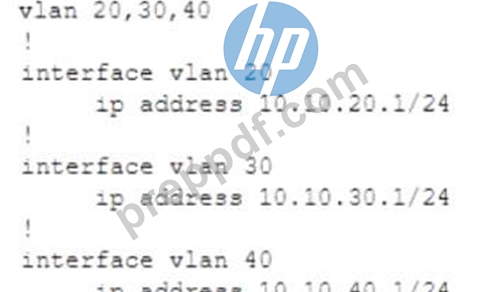
- A.

- B.
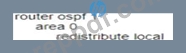
- C.
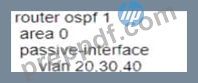
- D.
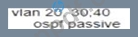
Answer: A
Explanation:
Explanation
OSPF (Open Shortest Path First) is a routing protocol that uses link-state information to calculate the best path to each destination in the network. OSPF establishes adjacencies with neighboring routers to exchange routing information and maintain a consistent view of the network topology1.
To establish an OSPF adjacency, the routers need to have some common parameters, such as the area ID, the network type, the hello interval, the dead interval, and the authentication method2. The routers also need to have a matching subnet mask on the interface that connects them3.
In this case, the Aruba CX 6300 VSF stack has an SVI (Switched Virtual Interface) on VLAN 10 with an IP address of 10.1.1.1/24 and a LAG (Link Aggregation Group) on port 1/1/1 and port 2/1/1 that connects to a neighboring device. The SVI is configured with OSPF area 0 and network type broadcast. The LAG is configured with OSPF passive mode, which means that it will not send or receive OSPF hello packets.
The neighboring device has an interface with an IP address of 10.1.1.2/24 and a LAG on port 1/0/1 and port
2/0/1 that connects to the Aruba CX 6300 VSF stack. The interface is configured with OSPF area 0 and network type broadcast.
Since the Aruba CX 6300 VSF stack and the neighboring device have the same area ID, network type, subnet mask, and default hello and dead intervals on their interfaces, they will be able to establish an OSPF adjacency over SVI 10 with LAG 1. The OSPF passive mode on the LAG will not affect the adjacency, because it only applies to the LAG interface, not the SVI interface.
NEW QUESTION # 43
Refer to the exhibit.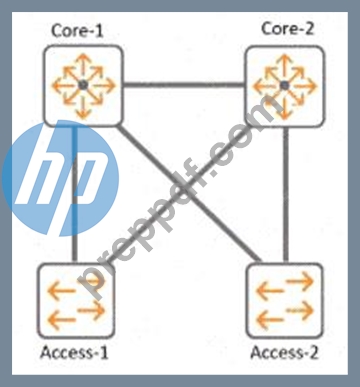
In the Core-2 configuration of spanning-tree instance 2 priority 0, what needs to be configured to enable the root for VLAN 20 while VLAN 10 remains root on Core-1?
- A. Spanning-tree priority 0 VLAN 20
- B. Spanning-tree instance 2 VLAN 20
- C. Spanning-tree VLAN 20
- D. Spanning-tree priority root VLAN 20
Answer: B
NEW QUESTION # 44
Match the appropriate QoS concept with its definition. (Options may be used more than once or not at all.)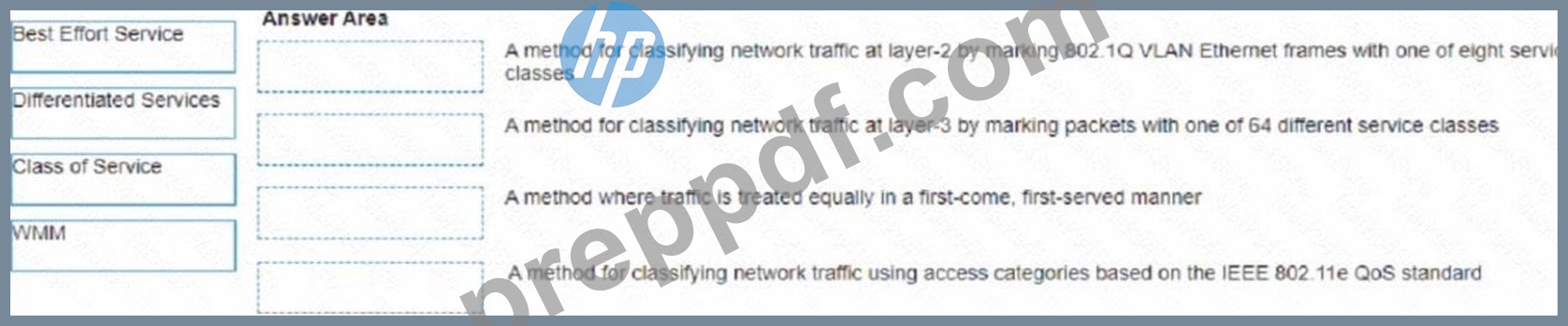
Answer:
Explanation: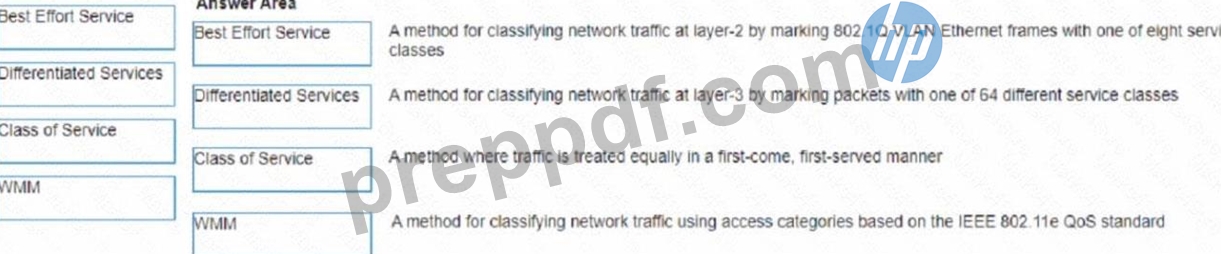
Explanation:
QoS concept: Class of Service Definition: 3) A method for classifying network traffic using access categories based on the IEEE 802.11e QoS standards QoS concept: Differentiated services Definition: 2) A method for classifying network traffic at layer-3 or marking packets with one of 64 different service classes QoS concept: WMM Definition: 4) A method for classifying network traffic using access categories based on the IEEE 802.11e QoS standards
NEW QUESTION # 45
Your Director of Security asks you to assign AOS-CX switch management roles to new employees based on their specific job requirements. After the configuration was complete, it was noted that a user assigned with the administrators role did not have the appropriate level of access on the switch. The user was not limited to viewing nonsensitive configuration information and a level of 1 was not assigned to their role.
Which default management role should have been assigned for the user?
- A. config
- B. operators
- C. sysadmin
- D. helpdesk
Answer: B
Explanation:
The operators user role is a predefined role that allows users to view nonsensitive configuration information on the switch, such as interfaces, VLANs, routing protocols, statistics, and more. The operators user role has a privilege level of 1, which is the lowest level of access on the switch.
The administrators user role is a predefined role that has full access to all switch configuration information and all REST API methods. This role is more than what the Director of Security requires.
NEW QUESTION # 46
You are configuring an SVI on an Aruba CX switch that needs to have the following characteristics:
* VLANID = 25
. IPv4 address 10 105 43 1 with mask 255 255 255.0
* IPv6 address fd00:5708::f02d:4df6 with a 64 bit prefix length
* member of VRF eng
* VRF eng and VLAN 25 have not yet been created
Which command lists will satisfy the requirements with the least number of commands?
- A.
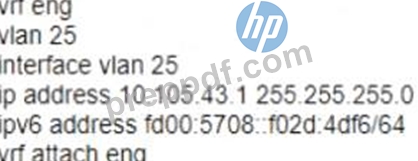
- B.
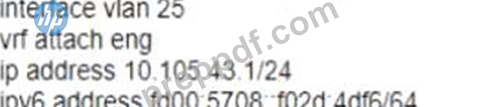
- C.
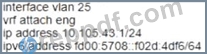
- D.
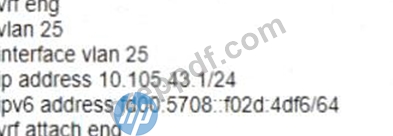
Answer: B
Explanation:
The other options either use more commands or do not create the VRF or the VLAN.
Option C uses the following commands:
* vrf eng: This command creates a VRF named eng and enters the VRF configuration mode1.
* vlan 25: This command creates a VLAN with ID 25 and enters the VLAN configuration mode2.
* interface vlan 25: This command creates an SVI on VLAN 25 and enters the interface configuration mode3.
* ip address 10.105.43.1/24 ipv6 address fd00:5780::102d:4df6/64 vrf attach eng: This command assigns an IPv4 address of 10.105.43.1 with a subnet mask of 255.255.255.0 and an IPv6 address of fd00:5780::
102d:4df6 with a prefix length of 64 to the SVI, and attaches it to the VRF eng.
NEW QUESTION # 47
You need to have different routing-table requirements with Aruba CX 6300 VSF configuration Assuming the correct layer-2 VLAN already exists how would you create a new OSPF configuration for a separate routing table?
- A. Attach OSPF process ID in the VRF configuration.
- B. Create a new OSPF area, and attach VRF name.
- C. Attach a new OSFP process ID with a custom routing table
- D. Create a new OSPF process ID with vrf name.
Answer: D
Explanation:
To create a new OSPF configuration for a separate routing table, you need to create a new OSPF process ID with vrf name. This will create a new OSPF instance that is associated with the specified VRF and its routing table. The other options are incorrect because they either do not create a new OSPF instance or do not associate it with a VRF. References:
https://www.arubanetworks.com/techdocs/AOS-CX/10.04/HTML/5200-6728/bk01-ch02.html
https://www.arubanetworks.com/techdocs/AOS-CX/10.04/HTML/5200-6728/bk01-ch03.html
NEW QUESTION # 48
......
Pass HP HPE7-A01 Actual Free Exam Q&As Updated Dump: https://certkingdom.preppdf.com/HP/HPE7-A01-prepaway-exam-dumps.html